Checkers
By Frank Force · MIT license. Source · All credits
About Checkers
Checkers with the rule most casual players leave out: captures are compulsory. If a jump is available you have to take it, which turns the game from moving pieces forward into setting traps, because a jump you force your opponent to take can be the jump that loses them three pieces. Reach the far row and your piece is crowned and can move both ways. Play the computer at three strengths or hand the device to someone across the table.
How to play
Tap a piece to select it, then tap where you want it to go. Pieces move diagonally forward. If a capture is available anywhere, you must take it.
Rules of Checkers
- The board is 8x8 and each player starts with twelve pieces on the dark squares of their three nearest rows.
- Ordinary pieces move one square diagonally forward, never backward and never onto a light square.
- You capture by jumping straight over an adjacent enemy piece into the empty square directly behind it.
- Captures are mandatory. If a jump exists you must play one.
- If another jump is available with the same piece after landing, the turn continues and you take it too.
- A piece reaching the opposite back row is crowned a King and from then on moves and jumps both forward and backward.
- You win by capturing every enemy piece, or by leaving your opponent with no legal move.
Controls
- Tap a piece to select it
- Tap a highlighted square to move there
- U undoes a move, R restarts
What makes it worth playing
- Captures are mandatory, which is what makes forcing sequences possible
- Multi-jumps chain in a single turn
- Kings are crowned at the far row and move in both directions
- Three computer strengths, or two players on one device
Screenshots
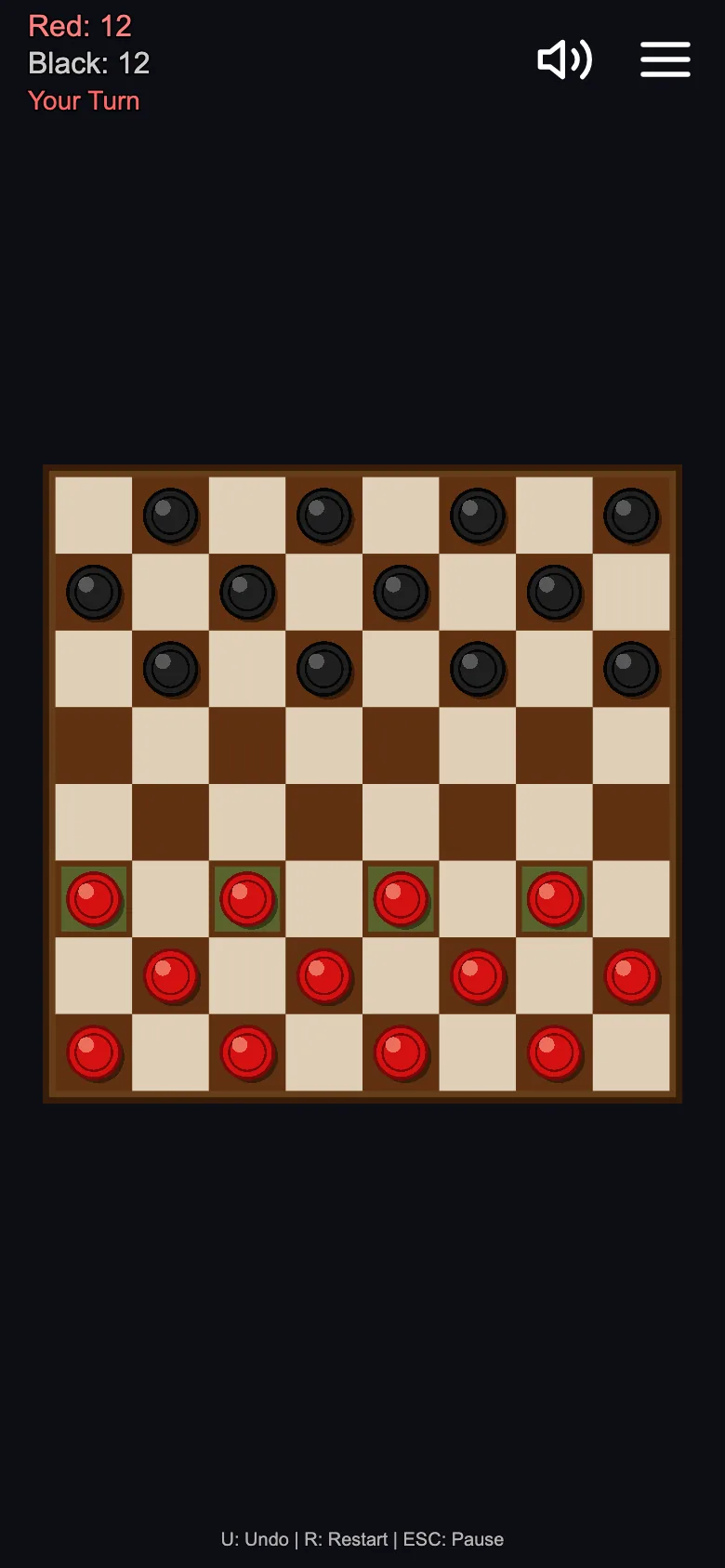
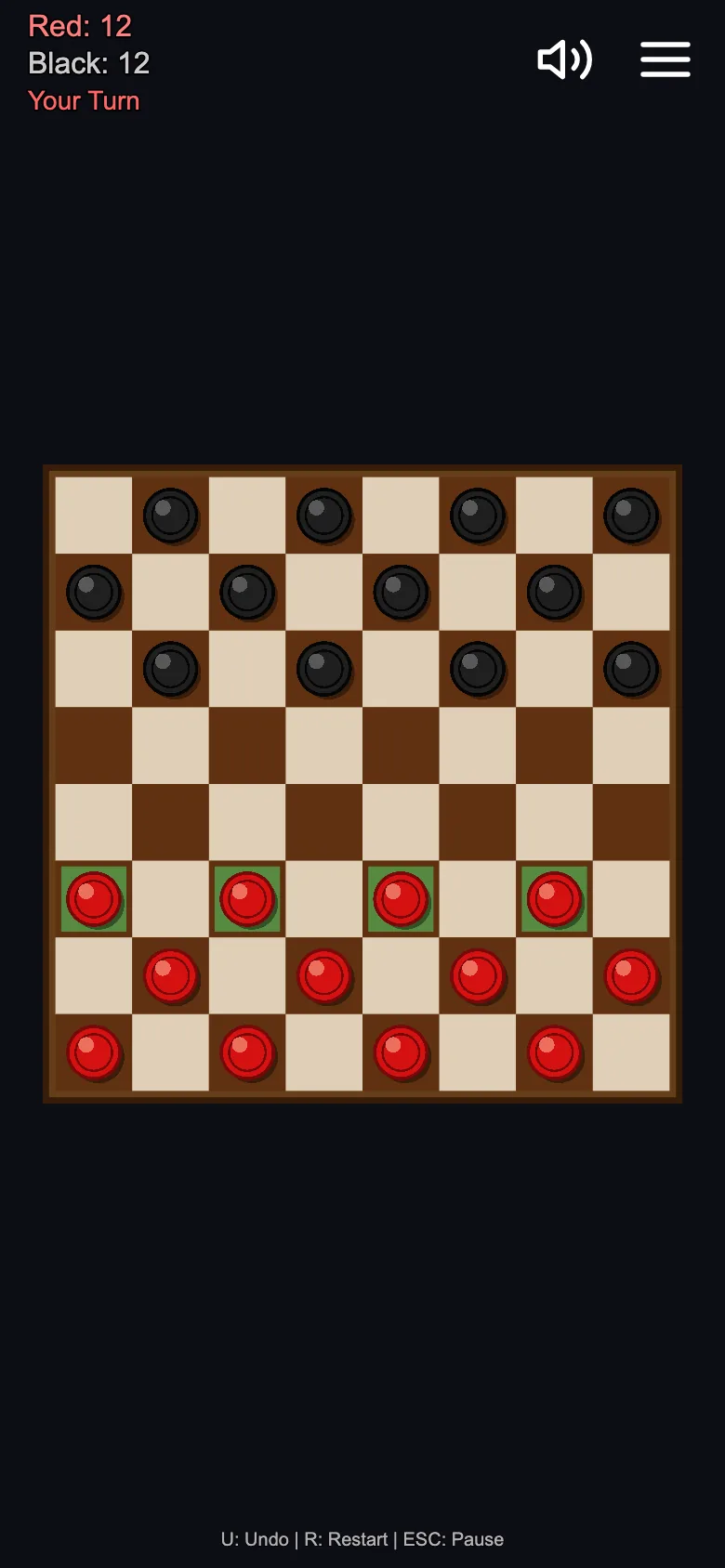
Captured from this build on 2026-08-27.
Tips from playing it
- Because captures are forced, you can offer a piece to pull your opponent out of position and take two back.
- Hold your back row as long as you can. Every gap in it is a square where they get crowned.
- Trade pieces when you are ahead. A two-piece lead in a twelve-piece game is small, in a four-piece game it is decisive.
Why this game is here, and what we changed
Chosen because it is a classic the arcade did not have and it supports two people on one device, which very few of our games do. Its difficulty buttons carried developer tooltips describing the search algorithm and its depth, which means nothing to a player, so we rewrote all three in plain language. We host it on our own servers, so it loads straight into the page with no third-party ad code and no pre-roll video, and its MIT licence is kept alongside it. We played it through at phone size on 2026-08-27 before publishing this page, and the screenshots above come from that session rather than from the original project.
More on how we pick and fix these: what we changed in the open-source games and how we test a game.
- Category
- Board
- Plays in
- Your browser, no download
- Orientation
- Portrait
- Players
- One player against the computer at three strengths, or two players sharing one device.
- Difficulty
- Simple to play, sharp once captures are forced
- Typical session
- 5 to 12 minutes a game
- Last tested by us
- 2026-08-27
- Created by
- Frank Force (MIT)