Lane Rush
About Lane Rush
Lane Rush is our own endless driver, built in three lanes so the whole game fits under one thumb. Traffic comes at you and you pick a lane. Squeezing past a car close enough to almost clip it pays a bonus, so the safe line is not the high-scoring one.
How to play
Swipe or tap left and right to change lane. Avoid the traffic. Passing a car closely scores a near-miss bonus on top of the distance you cover.
Rules of Lane Rush
- The road runs three lanes wide with dashed markers dividing them and solid lines on the verges.
- You can only ever be in a lane. There is no free steering and no half-way position between two of them.
- The score climbs on its own for as long as you stay alive, so it is really a measure of distance covered.
- Touching any car ends the run on the spot. There is no shield, no bump and no second chance.
- The end card reads Crashed and puts the run's score next to your best.
- That best is kept on the device and sits in the top right corner while you drive.
- Nothing pauses while you think, so every lane change is a decision made at speed.
Controls
- Swipe left or right to change lane
- Tap the left or right half of the screen as an alternative
- Arrow keys or A and D on a keyboard
What makes it worth playing
- Three lanes, which keeps it playable one-handed
- Near-miss bonus for passing close, so the safe line is not the best line
- A calm stretch roughly every eighteen seconds before the speed climbs again
- Traffic never blocks every lane, and never blocks the only lane you could still reach
- Speed and traffic density both climb, to a cap, over the first minute
- Arrow keys or A and D steer on a keyboard, so a run plays the same on a laptop
Screenshots
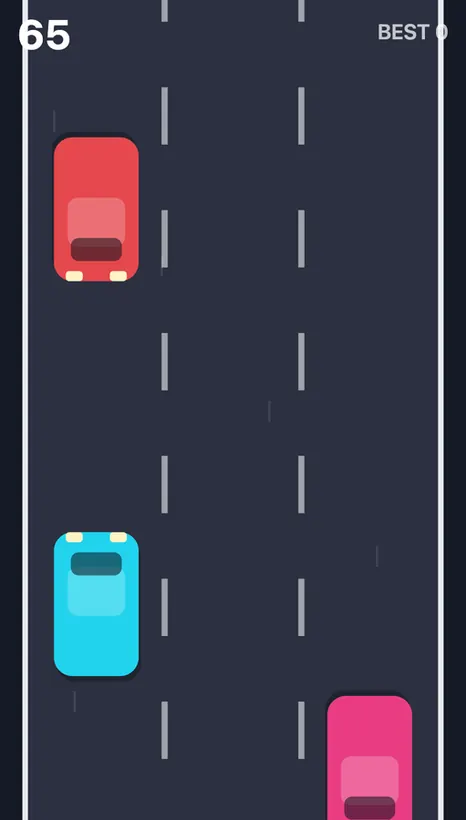
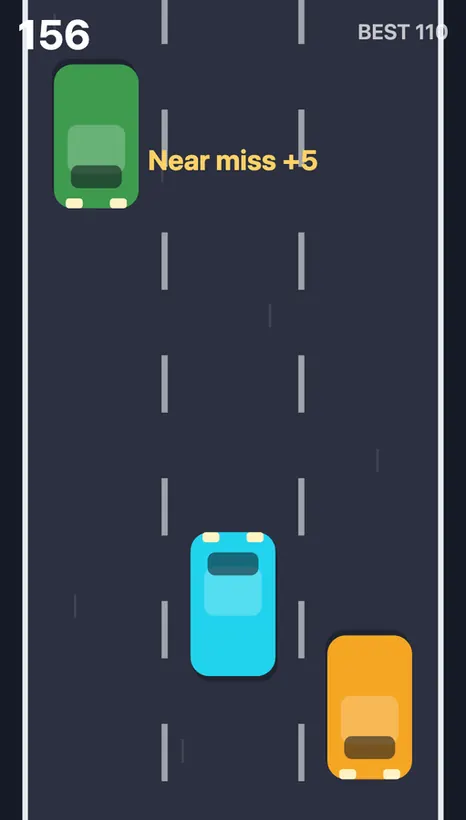
Captured from this build on 2026-08-26.
Tips from playing it
- Ride the middle lane when nothing is coming. From there you can move either way, which doubles your options.
- Take the near-miss when the gap is real. Five points a car adds up faster than the distance score does.
- The calm stretch is the moment to reposition, not to relax. Use it to get back to the middle.
- Commit early. Changing lane late is what kills runs, because the car you are dodging is already past the point where you could have gone around it.
Notes from building it
Two rules make this fair rather than annoying. The first is that a row of traffic never blocks every lane, and never blocks the last lane you could physically still reach in time. Endless runners that skip this check produce deaths the player could not have avoided, and an unavoidable death feels like the game cheated even when it was random. The second is the rhythm. Instead of a smooth difficulty ramp, the game grants a short calm stretch roughly every eighteen seconds, drops the speed back, and then climbs again. Speed rises from a slow start to a hard cap over about a minute, and the gap between traffic rows tightens from just over a second to a floor of a bit under half a second. A flat ramp is exhausting and, oddly, feels easier to quit. The breather is what makes the next fast section land.
More from the studio: why difficulty needs a rhythm and how we test a game.
We wrote about this one
- Why our endless games get easier every twenty seconds. A difficulty curve that only goes up stops feeling hard and starts feeling unfair. Here is the rest beat we build into Lane Rush and Star Salvo, and why.
- Category
- Racing
- Plays in
- Your browser, no download
- Orientation
- Portrait
- Players
- One player.
- Difficulty
- Forgiving for the first thirty seconds, then it has teeth
- Typical session
- 30 seconds to 3 minutes a run
- Last tested by us
- 2026-08-26
- Studio
- Our own game