Peg Drop
About Peg Drop
Peg Drop is about the one decision you get: where across the top to let go. After that the ball is on its own, rattling down ten rows of pegs into one of nine slots. The middle slot pays a hundred, the outside pair pay five, and the odds are stacked against you in a way that feels fair rather than mean. Ten balls to start, and one back every hundred points, so a decent run pays for itself and a poor one is over in ninety seconds. Nothing costs money and there is nothing to buy.
How to play
Slide your aim marker along the top of the board and let a ball go. It falls through the pegs and lands in whichever slot it finds. Watch the ball counter, because a run ends when it hits zero.
Rules of Peg Drop
- A run begins with ten balls and ends when you are out of them.
- Where the ball lands sets the score. The centre slot is the hundred and the two outside slots are worth five each.
- You bank one extra ball for every hundred points scored, counted on your running total.
- The aim marker only sets the release point. Every ball also gets a small random sideways nudge as it leaves, so the same aim twice is not the same drop twice.
- Balls can be dropped one after another, and more than one can be on the board at a time.
- A ball that has scored sits for about half a second and then bursts, shoving anything within a few peg widths of it sideways.
- Your highest total is stored on the device and shown above the board.
Controls
- Move the pointer or drag a finger across the board to aim
- Click, tap, or press Space to release a ball
- Left and Right also nudge the aim marker
What makes it worth playing
- Nine slots reading five, ten, twenty, fifty, a hundred, fifty, twenty, ten, five from the outside in
- Ten rows of pegs, which is enough for the fall to be unpredictable rather than a fixed groove
- An extra ball every hundred points, so a strong start buys you a longer run
- Every peg hit flashes and chimes, so a long clatter down the board is worth watching
- Your best total is kept, and there is no purchase of any kind
Screenshots
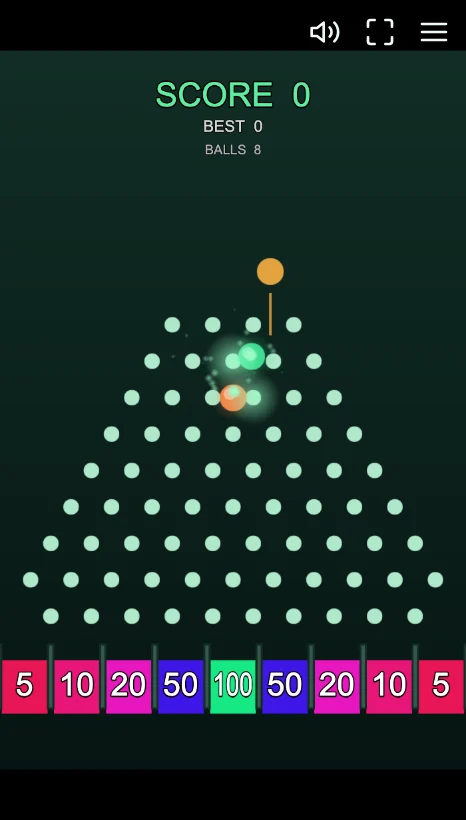
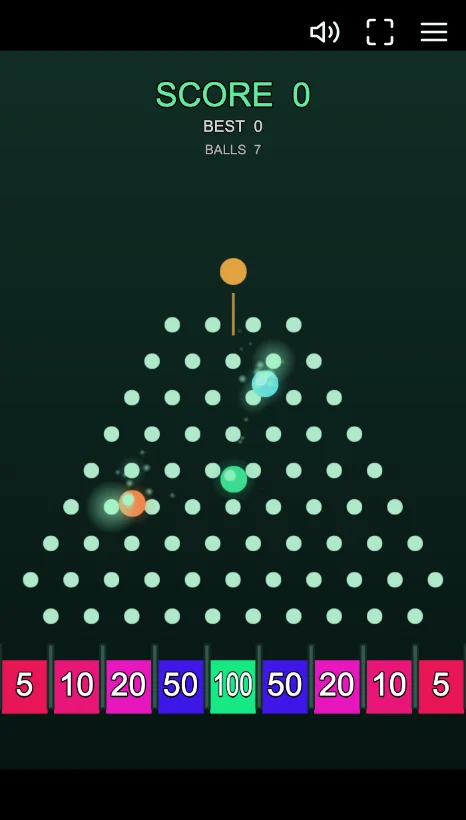
Captured from this build on 2026-09-14.
Tips from playing it
- Dropping dead centre is not the safe play it looks like. The first peg splits the ball one way or the other, so a small offset can run straighter than a bang on centre release.
- Watch where your balls land over five or six drops rather than where you aimed. The board has a bias and you can lean against it.
- With one ball left, aim for the mid value slots. Ten points banked beats a hundred you did not get.
- Stacking drops is a real tactic, but scored balls burst and shove their neighbours, so a crowded board scatters more than a patient one does. Use it when you are one slot short of the next extra ball, not as a habit.
Why this game is here, and what we changed
Slot value should be readable before you have found the number, so the bands run as a colour ramp: pink at the five point edges through to green at the hundred in the middle. Around them the board went deep forest green with mint pegs, and the aim marker is a hot amber dot over a pulsing dashed line, which is the one thing on the board that has to stay visible against all that dark green. The bit we left alone is the fuse on a scored ball. It sits for a beat, bursts, and shoves its neighbours, and that small mess is most of the charm.
More on how we pick and fix these: how we make our own editions of classic games and how we test a game.
- Category
- Casual
- Plays in
- Your browser, no download
- Orientation
- Portrait
- Players
- Alone at the board. Nobody else drops balls and nothing here is for sale.
- Difficulty
- Ten rows of pegs plus a random sideways nudge at release mean the drop point is a lean, not a steer, and no two identical aims land the same way.
- Typical session
- Two to six minutes a run.
- Last tested by us
- 2026-09-14