Planet Siege
About Planet Siege
Planet Siege is a small war over ten to fifteen worlds. Everything you hold builds ships by itself, so the game is never about clicking faster. It is about when to spend what you have built. Drag a line from one of your worlds to another and a stream of ships crosses the gap, one at a time, killing one defender each as they arrive. The crossing takes real seconds, and the defender keeps building the whole way, so the question is always what will be waiting when your fleet lands.
How to play
Press on one of your worlds, drag to a target and let go to send. The keys 1 to 4 set how much of the garrison goes with it.
Rules of Planet Siege
- Every world you hold builds ships on its own, and a bigger world builds faster and holds more.
- A garrison is capped at thirty ships for each unit of the world's radius.
- Arriving ships kill one defender each, and the world only changes hands once the garrison passes zero.
- Whatever survives the capture becomes your garrison on that world.
- You win by taking every enemy world, and you lose the moment you hold none.
- Skirmish gives you ten worlds, seventy ships to the enemy's twenty, and an opponent that misreads a garrison by up to a third.
- Campaign moves to fifteen worlds, cuts that misreading to about one part in eight, and has the opponent act almost twice as often.
- Siege starts you on forty ships against fifty, with an opponent that has perfect information and moves every second or so.
- The opponent will not attack from a world holding fewer than twenty two ships, and it sends half of what it has, or seventy per cent once it is over eighty five.
- You and your opponent always open on the two worlds furthest apart on the map.
Controls
- Press on one of your worlds and drag to the target, then release to send
- Keys 1 to 4 set the share sent: 10, 25, 50 or 100 per cent
- The mouse wheel adjusts the share mid drag, and snaps to those four
- R restarts and Escape pauses
What makes it worth playing
- Three settings that change the map size, both starting fleets and how sharply the opponent plays.
- Ships cross as a visible stream, so you can watch a fleet arrive and count it in.
- A live number on every world you can see, which is the whole information layer the game needs.
- One sitting per game, no save, no campaign map, nothing to unlock.
Screenshots
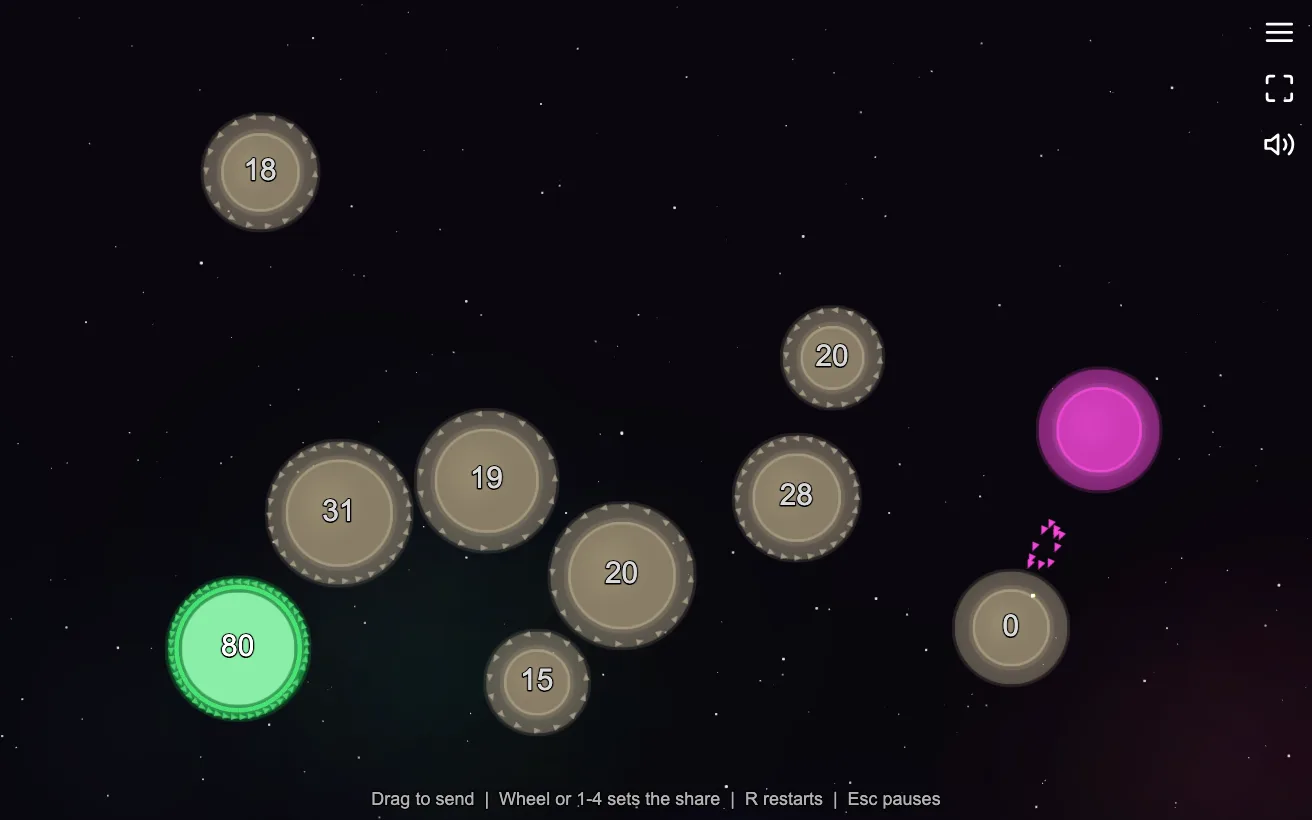
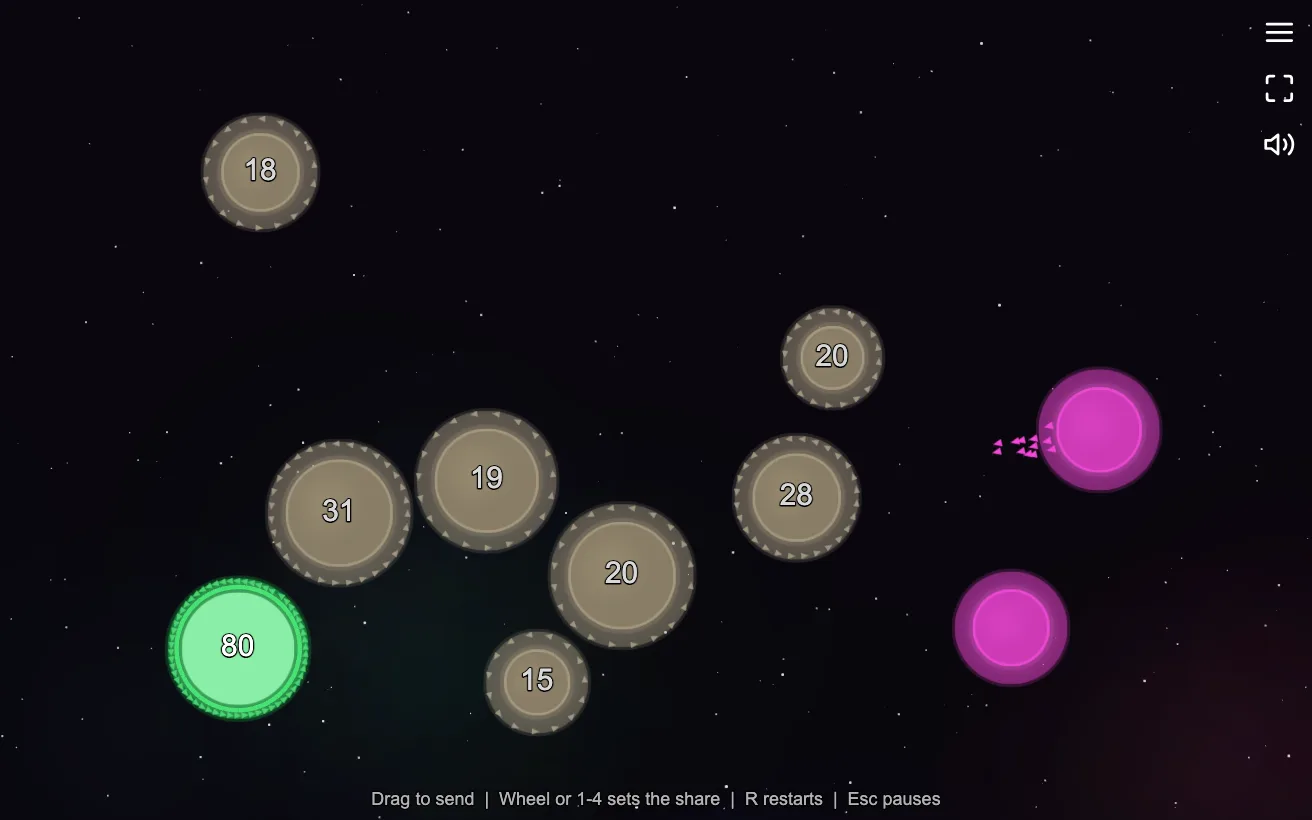
Captured from this build on 2026-09-14.
Tips from playing it
- Take the empty worlds nearest you first. A quiet start beats a brave one.
- Send enough to win or send nothing. A fleet that arrives short just donates itself to the defender.
- Count what will be defending on arrival, not what is there now. A long crossing is free building time for them.
- On Skirmish the opponent sits still below twenty two ships, so an early strike on its home world catches it while it is still saving up. On Siege it is over that line almost immediately.
Why this game is here, and what we changed
Every world wears a thin orbit ring in the colour of whoever holds it, two rings in fact, a brighter inner one and a faint outer. That is the change that matters: the state of the whole map reads from across the screen without counting a single number. Under it the palette is emerald for you, magenta for the opponent, warm sand for the unclaimed and an aubergine wash behind everything instead of flat black. The three settings are named Skirmish, Campaign and Siege. One thing we knowingly left alone is the sound, which is stubbed out in this build, so it plays silent.
More on how we pick and fix these: how we make our own editions of classic games and how we test a game.
- Category
- Strategy
- Plays in
- Your browser, no download
- Orientation
- Landscape
- Players
- One commander against one machine opponent.
- Difficulty
- On Siege the opponent reads every garrison exactly, opens on fifty ships against your forty, and picks a new target roughly every second.
- Typical session
- Four to ten minutes a game.
- Last tested by us
- 2026-09-14