Prism Match
About Prism Match
Prism Match is an eight by eight grid of coloured gems and one rule: swap two neighbours to make a line of three or more, and the line disappears. What makes it worth playing is what happens next. Everything above the gap drops, fresh gems fall in from the top, and if those landings happen to line up as well they clear too, with every step of the chain paying more than the one before it. There is no clock and no move limit, so a run lasts exactly as long as you keep finding swaps.
How to play
Drag a gem onto the one beside it to trade places. If the swap makes no line of three the two gems slide back and nothing is lost.
Rules of Prism Match
- The grid is eight columns by eight rows and always starts with no line already made.
- A swap is only legal between two gems that share an edge.
- A swap that does not create a line of three or more is undone and costs you nothing.
- Three or more of the same gem in a row or a column clear together.
- Gems above a cleared space fall down into it, and new ones drop in from the top of the column.
- If those falling gems land in a line they clear as well, and that keeps going for as long as lines keep forming.
- A clear scores the number of gems taken multiplied by how many steps deep the chain is, so later steps pay far more.
- There is no timer and no move limit, and R deals a fresh grid whenever you want one.
Controls
- Drag a gem onto a neighbour to swap the pair
- Vertical and horizontal swaps both work, diagonals do not
- R deals a fresh grid, ESC pauses
- Your best score is shown on the front screen
What makes it worth playing
- Seven gem shapes, circle, star, heart, diamond, triangle, bolt and cross, each with its own colour and outline, so they stay apart for anyone who reads shape faster than colour.
- Clears cascade on their own, and the score popup turns mint once a chain reaches its second step.
- The backdrop brightens and its rays spin faster the longer a chain runs.
- Gems fall faster the deeper into a chain you are, so a long cascade resolves quickly rather than dragging.
- Your best score is kept on the device and shown before you start.
Screenshots
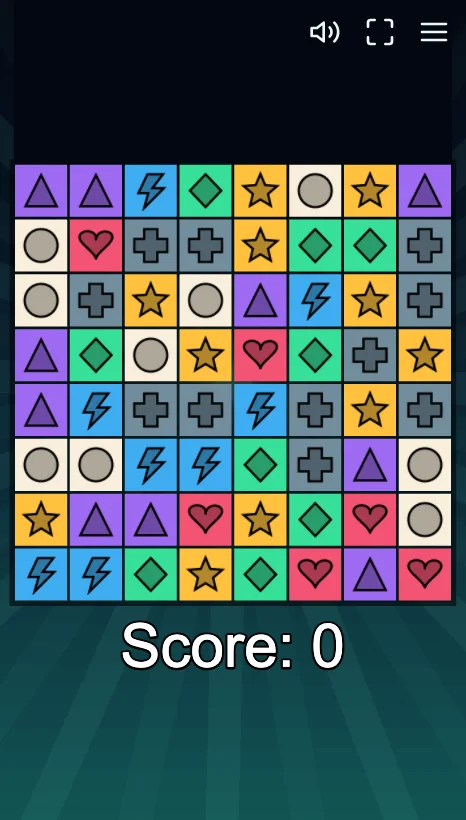
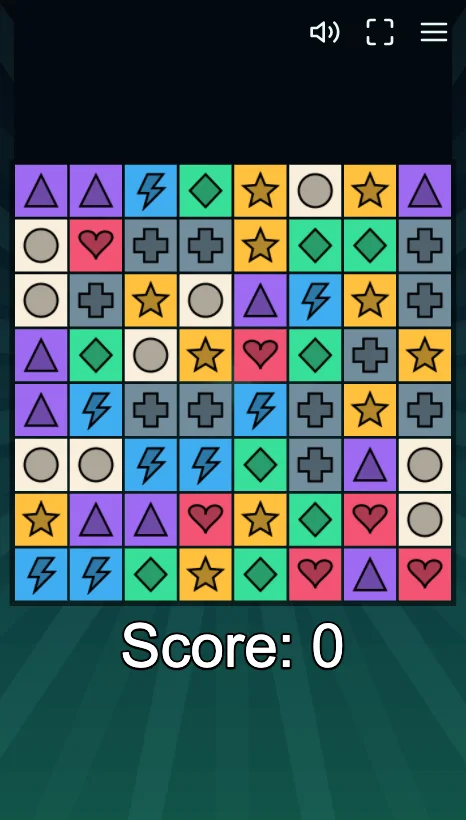
Captured from this build on 2026-09-14.
Tips from playing it
- Scoring is the length of the clear multiplied by how deep into the chain it is, so the fifth link of a cascade pays five times what the same three gems would have paid on their own.
- Work from the bottom of the grid. A clear down there drops everything above it and can set off a chain you did not plan.
- Before you commit, look at what is sitting directly above your match. That is what lands next.
- Four in a line clears four gems for the same chain step, so nudge a fourth gem into place rather than taking the quick three.
- There is no reshuffle in this build. If the board runs out of swaps, press R and take a fresh grid.
Why this game is here, and what we changed
Seven gems and six of them the same shape is a bad deal for anyone who does not read colour well, so every type here is a distinct silhouette baked into the atlas: circle, star, heart, diamond, triangle, bolt and cross. The palette was retuned underneath them, bone and amber and coral through mint and violet to a cool slate, on a teal to indigo backdrop that holds its band instead of drifting round the wheel. Cascade scoring stayed as it was, multiplier and all. It is the reason a good drop feels like a good drop.
More on how we pick and fix these: how we make our own editions of classic games and how we test a game.
- Category
- Match 3
- Plays in
- Your browser, no download
- Orientation
- Portrait
- Players
- Solo play, with a personal best held on the device.
- Difficulty
- Nothing chases you here. The only pressure is finding the swap whose fall sets off another one, because the chain multiplier is where the whole score lives.
- Typical session
- Five to twenty minutes a run, and you choose when to stop.
- Last tested by us
- 2026-09-14