Soft Landing
About Soft Landing
Soft Landing asks for one thing and checks it three ways. Put the craft down on the lit pad, slowly, close to upright, with nothing hanging over the edge. Thrust pushes along whatever direction the nose happens to be facing, so every correction starts with a turn. Gravity never lets up and the tank is smaller each time. The instrument panel tells you exactly how close you are to the limits, which is the difference between guessing and flying.
How to play
Turn with the left and right controls, then hold thrust to burn. Kill your sideways drift while you still have altitude, straighten up, and let the last few metres go slowly.
Rules of Soft Landing
- The craft touches down on three points, the two foot pads and the base of the body. Every one of them that reaches the ground has to be inside the pad, so catching the edge is a crash.
- Touchdown speed must be under one tenth of a unit, and tilt under twenty two hundredths of a radian, which is around thirteen degrees off vertical.
- A safe landing pays a hundred for each level reached, four for every unit of fuel still in the tank, and up to another hundred for how gently you arrived.
- The engine drains twenty fuel a second while it is running, and running dry leaves you falling with no way to slow down.
- Terrain, pad position and pad width are all rebuilt at the start of every level.
- Crashing ends the attempt. Your running total is saved as your best if it beats the old one.
Controls
- Hold thrust, or Up, or Space, to fire the main engine
- Left and right, or the stick on a touchscreen, turn the craft
- Thrust follows the nose, so point the way you want to push before you burn
What makes it worth playing
- Live readouts for fuel, descent rate, tilt and altitude, each with the safe limit marked on the bar
- A pad that narrows level by level, from six units wide down to a floor of three and a bit
- A tank that starts at eighty and loses six a level until it bottoms out at forty two
- Ground that is generated fresh every level, with the pad dropped at a random point along it
- Gravity that gets slightly heavier for the first eight levels and then holds
Screenshots
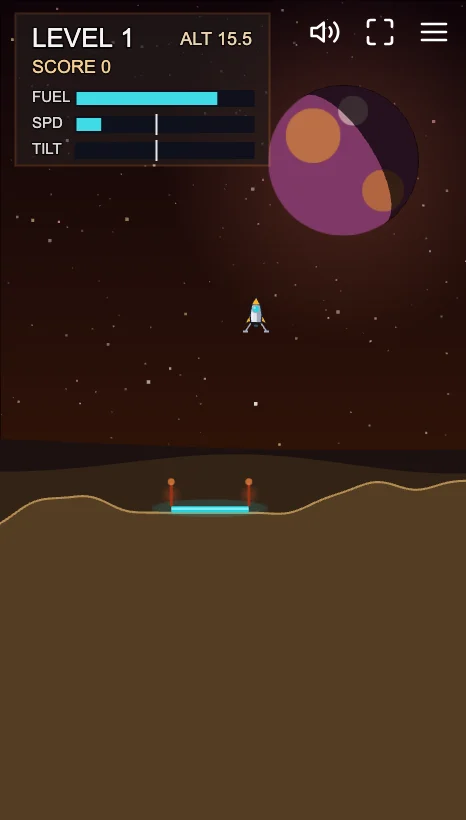
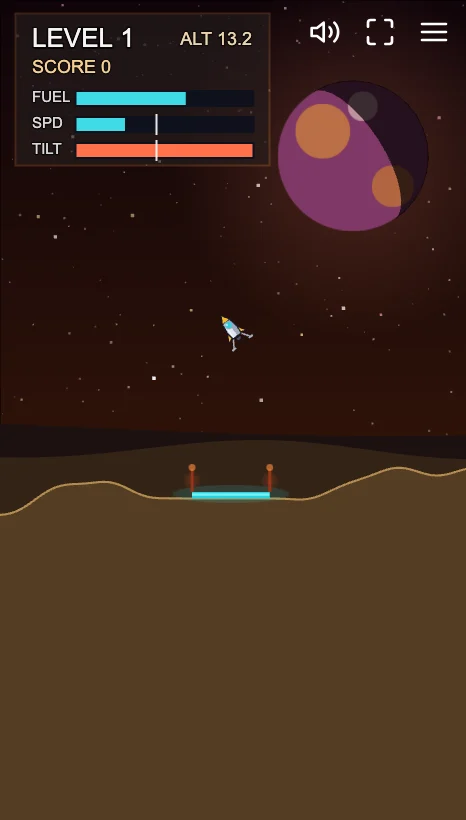
Captured from this build on 2026-09-14.
Tips from playing it
- Kill your sideways speed high up where you have room to fix an overcorrection. Drift is much harder to cancel near the ground.
- Short taps on the thruster cost a fraction of what one long burn does, and they hold your descent rate just as well.
- Straighten the nose before the last few metres. Tilt is measured at the exact moment of contact, not on the way in.
- The soft touchdown bonus is a hundred minus nine hundred times your landing speed, so anything above about eleven hundredths of a unit pays nothing extra. Arriving at a crawl is worth real points.
Why this game is here, and what we changed
The instrument panel does the heavy lifting here, so it sits top left, clear of the toolbar, with fuel, speed and tilt as bars and the safe limit marked as a white tick on each one. Speed and tilt sit cyan inside the window and go orange outside it, which is the only warning the game gives. The setting moved as well: rust dusk sky, ochre ground with a lit rim, cyan pad between two pulsing beacons, and a strange world hanging high in the sky rather than a familiar one. Flight model, fuel burn and the difficulty ramp are all as found.
More on how we pick and fix these: how we make our own editions of classic games and how we test a game.
- Category
- Simulation
- Plays in
- Your browser, no download
- Orientation
- Portrait
- Players
- Just the pilot, and a running total saved whenever it beats the last one.
- Difficulty
- Speed under a tenth of a unit and tilt under thirteen degrees at the exact frame of contact, on a pad that loses nearly half a unit of width every level down to three and a bit.
- Typical session
- Two to six minutes a level.
- Last tested by us
- 2026-09-14