Word Reef
About Word Reef
Word Reef is our own underwater merge puzzle. Words drift up as bubbles and you merge ones that belong to the same group. Four of a group completes it and clears it off the board. A hundred levels deep, with frozen bubbles, key-and-lock pairs and burst timers arriving as you go.
How to play
Drag one word bubble onto another from the same group to merge them. Four in a group completes it and clears it away. New bubbles keep arriving in waves, so a stalled board fills up fast.
Rules of Word Reef
- The counter at the top of the board reads how many groups you have completed out of how many the level wants.
- The bubbles drift continuously, so you are dragging one moving target onto another rather than clicking a static grid.
- Merging is a drag. Nothing on the board responds to a plain tap.
- The subtitle names the chapter and your place inside it, and the opening chapter, Shallow Reef, runs ten levels.
- Three helpers sit along the bottom, Hint, Magnet and Shuffle, and Shuffle costs nothing at all.
- Coins collect in the counter at the top right of the board.
Controls
- Drag a word bubble onto another to merge them
- Tap Hint to be shown a valid merge
- Tap Magnet to pull every loose bubble in one group together into a single merge
- Tap Shuffle when the board has stalled, which costs nothing
What makes it worth playing
- A hundred levels with a real difficulty rhythm rather than a straight ramp
- Groups complete at four, so you always have a clear target
- Frozen bubbles from level thirty, which need several merges before they thaw
- Key and lock pairs from level fifty, colour matched so you can see which key opens which
- Burst timers from level eighty-one, on a countdown that will fail the level
- Obstacles appear on about a third of levels and never on a difficulty spike
Screenshots
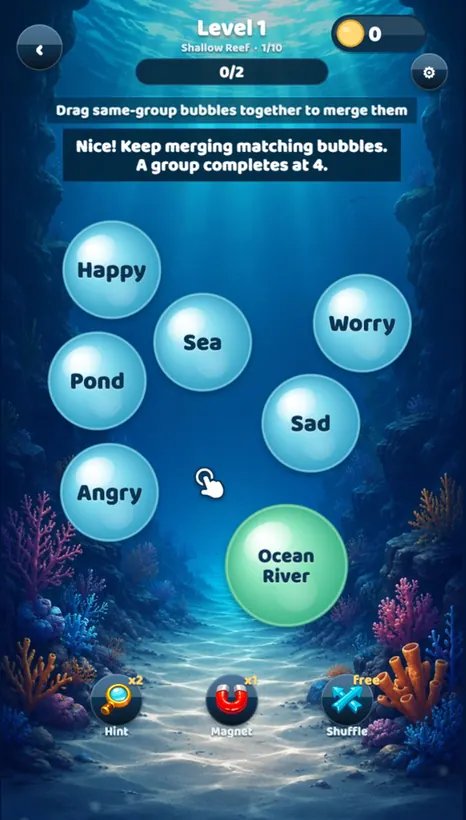
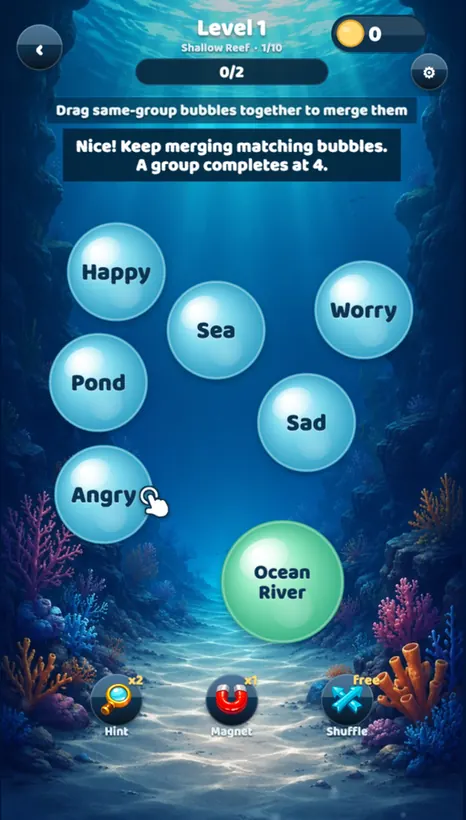
Captured from this build on 2026-08-26.
Tips from playing it
- Free the keys before anything else once locks appear. A lock cannot merge, so a board full of locks and no keys deadlocks.
- Work frozen bubbles early. They need several merges to thaw and the clock does not stop while you ignore them.
- Merging is what frees up space. When the board is crowded, take any valid merge rather than holding out for a better one.
- Shuffle is not an admission of defeat. A stalled board costs you more than the shuffle does.
Notes from building it
The most useful thing we learned building this was that our mistake allowance was far too harsh, and we only found out by measuring instead of guessing. The move limit in this kind of game is not a move count, it is a budget for how many mistakes you may make, and ours allowed about three where it should have allowed around ten. We were harsher nearly everywhere, which reads to a player as an unfair game rather than a hard one. Fixing it meant giving the allowance a rhythm too: four tiers of slack, with tighter spikes every fifth level between twenty-five and seventy-five, and none at all in the last twenty levels where the obstacles are already supplying the pressure. The other rule is that two pressures never share a board. If a level has an obstacle and a tight budget at once, a player who fails cannot tell which one killed them, and a failure you cannot learn from is just noise.
More from the studio: why difficulty needs a rhythm and how we test a game.
- Category
- Word
- Plays in
- Your browser, no download
- Orientation
- Portrait
- Players
- One player.
- Difficulty
- Gentle to level thirty, then the obstacles change the game
- Typical session
- Two to six minutes for most levels
- Last tested by us
- 2026-08-26
- Studio
- Our own game