Cobalt Freecell
About Cobalt Freecell
Cobalt Freecell deals all fifty two cards face up across eight columns and then leaves the rest to you. Nothing is hidden, nothing is shuffled again, and there is no pile to turn over for luck. Four corner cells hold one card each as temporary parking, four more build the suits up from ace to king, and the size of the run you can shift at once depends entirely on how many of those cells you have left empty. Almost every deal can be solved. Whether this one gets solved is a question about your planning rather than about the cards.
How to play
Drag a card to where it should go. Double tap a card to send it straight up to its suit pile, and anything that can safely follow it goes up on its own.
Rules of Cobalt Freecell
- All fifty two cards are dealt face up into eight columns, four of seven cards and four of six.
- Four single cells sit in the top left and hold one card each, and any card may go into an empty one.
- The four piles on the top right are built up by suit, starting with the ace and finishing with the king.
- Inside a column, cards go down in rank and alternate in colour, so a black eight takes a red seven.
- Any card can be moved into a completely empty column, not just a king.
- Only one card really moves at a time, so the length of run you can shift depends on your free cells and empty columns.
- Every card is face up from the start, which means there is no luck left once the deal is on the table.
- The deal is won when all four suits are stacked ace to king on the top right.
Controls
- Drag a card, or a legal run, onto its destination
- Double tap or double click a card to send it home to its suit
- Z steps back, Y steps forward again
- The circular arrow in the top bar abandons the deal and lays out a new one
What makes it worth playing
- Undo and redo run the whole way back through a deal, so a wrong turn costs nothing but time.
- An unfinished deal is kept, and the front screen offers Continue instead of Play when there is one waiting.
- While you are holding a card, every column that would legally take it lights up, and the hint tint can be switched off in Options.
- Hover a card with an empty hand and the run that would lift with it is tinted, so you can see the size of the move first.
- A legal run travels as one block, and the game works out how many cards that is from the space you have.
Screenshots
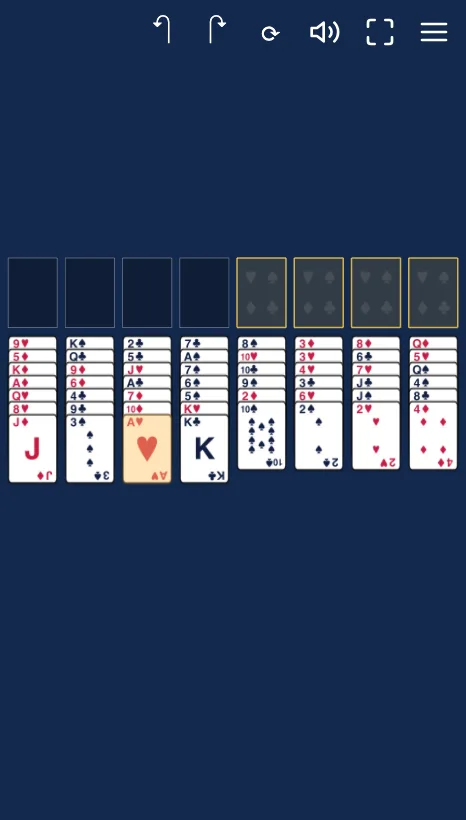
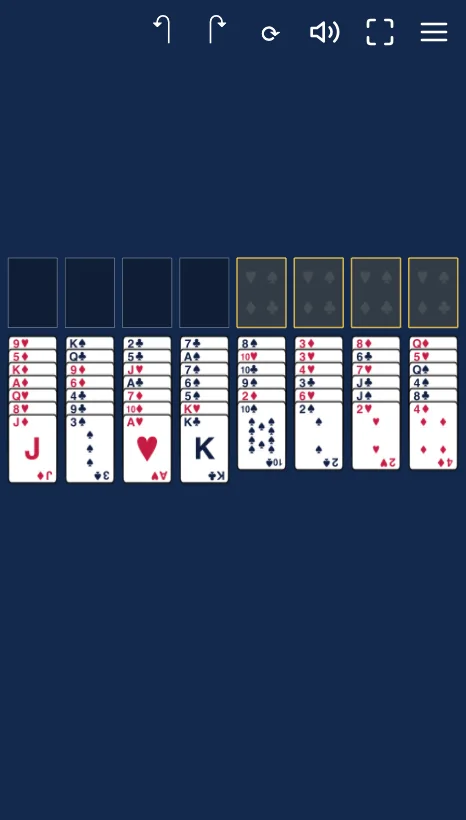
Captured from this build on 2026-09-14.
Tips from playing it
- The move limit is one plus your empty cells, doubled for every empty column. Three free cells and one empty column shifts eight cards, and filling that column halves it.
- Empty a column before you fill a cell. A clear column is worth far more than a parked card, because anything can go into it.
- Work out where the aces are buried on the very first look, and plan the deal around digging out the deepest one.
- The automatic send home only fires for cards that can no longer be useful below, so a low card you still need will stay put. Do not wait for it.
- If you are stuck, step back five or six moves rather than one. The mistake is usually earlier than it feels.
Why this game is here, and what we changed
Two card games on one site needed two colour stories, so the ink went first. Hearts and diamonds are carmine here rather than postbox red, clubs and spades a very dark navy, and the whole table sits on cobalt. The empty slots follow: steel blue frames around the free cells, teal around the foundations, with a faint pip inside each. The highlight pair changed too, amber for the run you are about to lift and pale teal for where it can land. We kept the deal exactly as it comes, seven, seven, seven, seven, six, six, six, six.
More on how we pick and fix these: how we make our own editions of classic games and how we test a game.
We wrote about this one
- How we make our own editions of classic games. A tableau of cards, a sliding tile square, four discs in a row. Nobody owns those rules. Here is what goes into turning one of them into a game that holds up on a phone.
- Category
- Card
- Plays in
- Your browser, no download
- Orientation
- Portrait
- Players
- A patience game, so the only opponent is the deal in front of you.
- Difficulty
- Every card is visible from the start, so the pressure is the supermove formula: one plus your free cells, doubled for each empty column, and it collapses the moment you park something.
- Typical session
- Five to fifteen minutes a deal.
- Last tested by us
- 2026-09-14