Arrow Puzzle
About Arrow Puzzle
Arrow Puzzle is our own logic game. Every tile on the board is an arrow, and tapping one sends it flying in the direction it points. It only leaves the board if nothing blocks its path, so the order you clear them in is the entire puzzle. The campaign runs a thousand hand-tuned levels, from three-move warm-ups to boards that take real planning.
How to play
Tap an arrow to fire it in the direction it points. It only flies free if the path ahead is clear, so work out which arrows unblock which. Clear every tile to finish the level.
Rules of Arrow Puzzle
- An arrow only flies if every tile between it and the edge of the board is empty. Tap a blocked one and nothing happens at all.
- The counter beside the arrow icon starts at the level's par and ticks down as you clear tiles.
- Three hearts sit next to that counter, and the badge on the right names the difficulty band the board belongs to.
- Clear every arrow and the level is over. Finish with your hearts intact and the results card grades the run Flawless.
- The hint button carries a small numbered badge showing how many hints the board has left in it.
- Undo has no counter and no cost, so a move you are unsure about is always reversible.
- The results card offers the next level straight away, and the grid button takes you back to any board you have already reached.
Controls
- Tap an arrow to fire it
- Tap undo to take back the last move, as many times as you like
- Tap the hint button when a board stops making sense
What makes it worth playing
- A thousand-level campaign, plus endless boards and a daily puzzle
- Every level is a solvable logic problem, never a reflex test
- Arrows clear in chains, so ordering is the whole puzzle
- Every sixth level is a marked hard board, so the difficulty has a pulse instead of a slope
- Unlimited undo, which means experimenting costs you nothing
- Each board carries its own hint allowance, counted on a badge so you know what is left in it
Screenshots
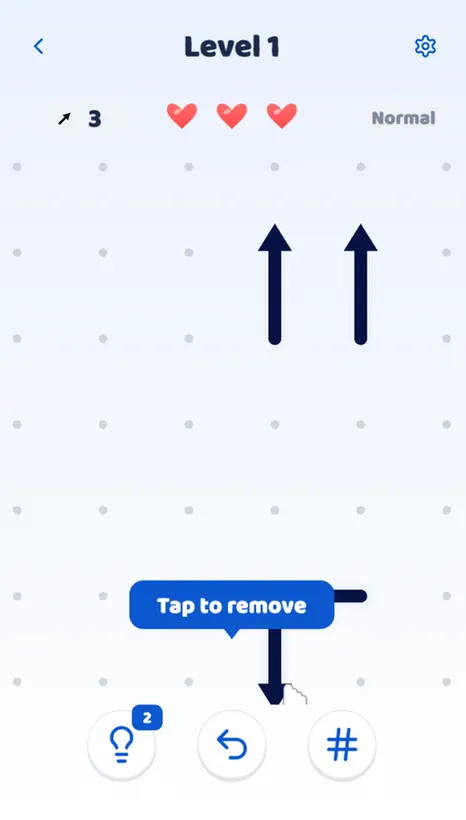
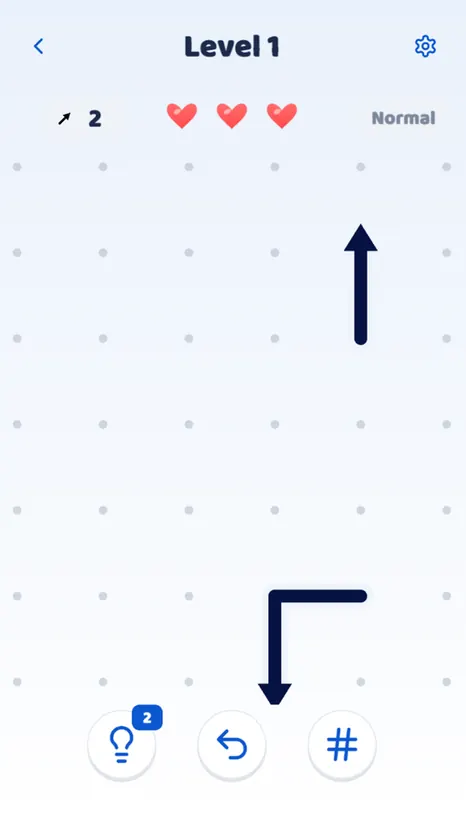
Captured from this build on 2026-08-26.
Tips from playing it
- Work from the edges inward. Arrows pointing off the nearest edge are usually the only ones that can move at all on the first turn.
- Before you tap, follow the arrow's whole path to the edge. One tile in the way and the move does nothing.
- When you stall, undo three or four moves rather than restarting. The mistake is usually near the end, not the beginning.
- On the marked hard levels, look for the arrow that is blocking the most other arrows and plan backwards from it.
Notes from building it
The rule that makes this game work is that a level is never unsolvable. Every board is generated against a fill target and then checked, so there is always an order that clears it. That sounds obvious until you play a puzzle game that gets it wrong, at which point you stop trusting the game and stop playing. The other decision worth naming is the pacing. We mark every sixth level as a hard one instead of raising difficulty a little on every level. A smooth ramp reads as unfair, because you never get the beat of relief that makes the next spike feel earned. Grouping the hard boards into a rhythm means a player finishes a tough one, gets a few lighter boards to enjoy being good at the game, and then meets the next wall ready for it.
More from the studio: why difficulty needs a rhythm and how we test a game.
- Category
- Puzzle
- Plays in
- Your browser, no download
- Orientation
- Portrait
- Players
- One player.
- Difficulty
- Gentle for the first fifty levels, genuinely hard by the hundreds
- Typical session
- 1 to 4 minutes a level
- Last tested by us
- 2026-08-26
- Studio
- Our own game