Koaladoku
About Koaladoku
Koaladoku is our own logic puzzle with a cosy koala theme, and it is not a sudoku. You place exactly one koala in every row, in every column, and in every coloured region, and no two koalas may touch, not even at a corner. Every board has exactly one solution, and every one can be reached by pure deduction.
How to play
Place one koala in each row, each column, and each coloured region. No two koalas may touch, including diagonally. A single tap crosses a square out and a double-tap drops a koala into it, so mark what you have ruled out as you go. There is exactly one correct answer on every board.
Rules of Koaladoku
- Exactly one koala goes in every row.
- Exactly one koala goes in every column.
- Exactly one koala goes in every coloured region.
- No two koalas may touch each other, including diagonally.
- Every board has exactly one solution, and you never need to guess to find it.
- Three chips above the board restate the constraints while you play: one per colour, one per row and column, and no touching.
- The counter beside the koala face tracks how many you have placed against how many the board needs. The opening board asks for four.
- Hearts sit next to that counter, and a placement that breaks a rule costs you one of them.
- Double-tap an empty tile to drop a koala into it. A single tap, or a swipe across a run of tiles, crosses them out instead.
- The Daily Challenge unlocks at level twelve and the untimed Zen mode at level fifteen. The home screen says so on the locked cards rather than hiding them.
- A streak card on the home screen counts the days you have played in a row.
Controls
- Tap an empty square to cross it out, and tap it again to clear the cross
- Double-tap an empty square to place a koala in it
- Swipe along a row or a column to cross out a whole run in one go
- Tap a placed koala to take it back off the board
What makes it worth playing
- Over eleven hundred boards, each one checked for a unique solution
- Five deduction difficulty ranks, from simple singles up to chain reasoning
- Board sizes grow as you improve
- Cross out the squares you have eliminated, which is how the harder boards get solved
- A daily challenge and a streak counter
- Zen mode with no timer at all
Screenshots
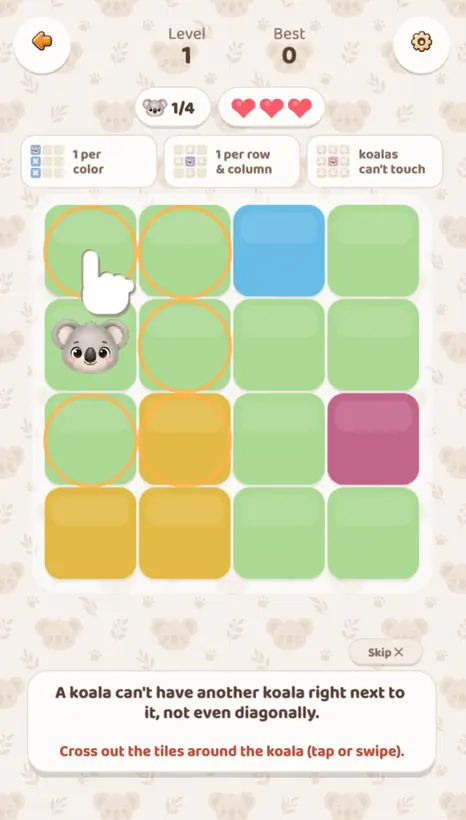
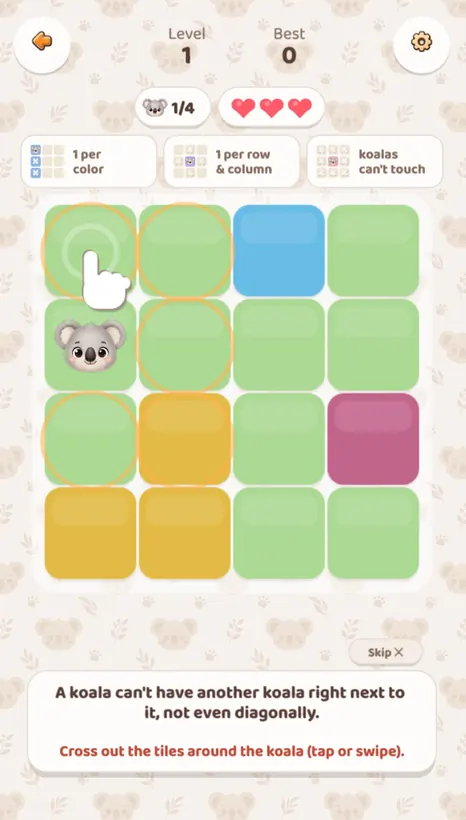
Captured from this build on 2026-08-26.
Tips from playing it
- Start with the smallest region on the board. Fewer squares means fewer places its koala can go.
- Every koala you place kills eight neighbouring squares as well as its row and column. Mark all of them before looking for the next move.
- If a row has only one square left that is not crossed out, that square is a koala. Most of the game is finding that situation.
- You never have to guess. If you feel like you are guessing, there is a deduction on the board you have not spotted yet.
Notes from building it
The number that matters here is one: every board has exactly one solution. That is not a nice-to-have in a deduction puzzle, it is the difference between a puzzle and a guessing game, because the moment two solutions exist there are positions where logic cannot tell you which way to go. So every board in the bank is validated when the game loads it, and any board that fails is dropped rather than shown. The pool is a little over eleven hundred, sorted into buckets by board size and by how hard the deduction is, and the game draws from the bucket that matches where the player is. We also cycle each board through its eight reflections and rotations, which means a modest set of hand-checked boards yields a much larger set of boards that feel new without any of them being unverified.
More from the studio: why difficulty needs a rhythm and how we test a game.
Koaladoku is also on Android. Get it on Google Play. That is the only place we link installs from.
- Category
- Puzzle
- Plays in
- Your browser, no download
- Orientation
- Portrait
- Players
- One player.
- Difficulty
- Starts gentle, and the top ranks need real chain deduction
- Typical session
- 2 to 10 minutes a board depending on size
- Last tested by us
- 2026-08-26
- Studio
- Our own game