Slide Fifteen
About Slide Fifteen
Slide Fifteen is the little sliding tile puzzle: fifteen numbered squares in a four by four tray with a single gap. Tap a tile next to the gap and it slides across. Put the numbers back in order, one to fifteen reading left to right along the rows, and the tray is solved. Scramble deals a fresh arrangement whenever you want one, and Solve walks the board back into order if you would rather watch it happen than do it yourself.
How to play
Tap any tile sharing an edge with the empty square and it slides into the gap. Tap further along the same row or column and the whole line shifts.
Rules of Slide Fifteen
- Fifteen numbered tiles sit in a sixteen square tray, so there is exactly one empty space at any time.
- Only a tile touching the gap can move, and it can only move into the gap.
- Tap a tile further down the same row or column and every tile between it and the gap slides along with it.
- The tray is solved when the numbers read one to fifteen across the rows with the gap at the bottom right.
- There is no failure state and no clock. A scramble that looks hopeless is still solvable.
- Scramble only ever deals arrangements that can be solved, so no run is a dead end.
- Solve plays the sequence that returns the tray to order, one slide at a time, and you can watch the route it takes.
Controls
- Tap a tile beside the gap to slide it
- Tap further along a row or column to slide several at once
- Scramble deals a new arrangement
- Solve returns the tray to order
What makes it worth playing
- Row and column slides, so three tiles move on one tap instead of three.
- Every scramble is guaranteed solvable, which a plain random shuffle cannot promise.
- Tiles animate over about a seventh of a second, quick enough to chain taps without waiting.
- The whole thing is a few kilobytes and opens instantly on a weak connection.
Screenshots
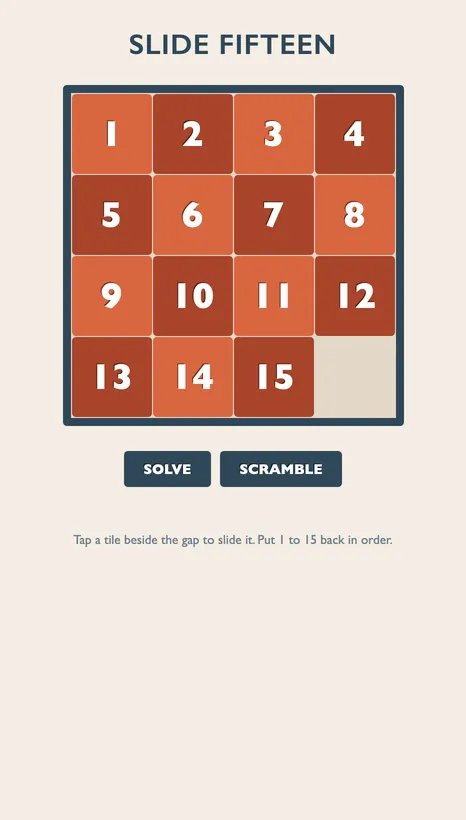
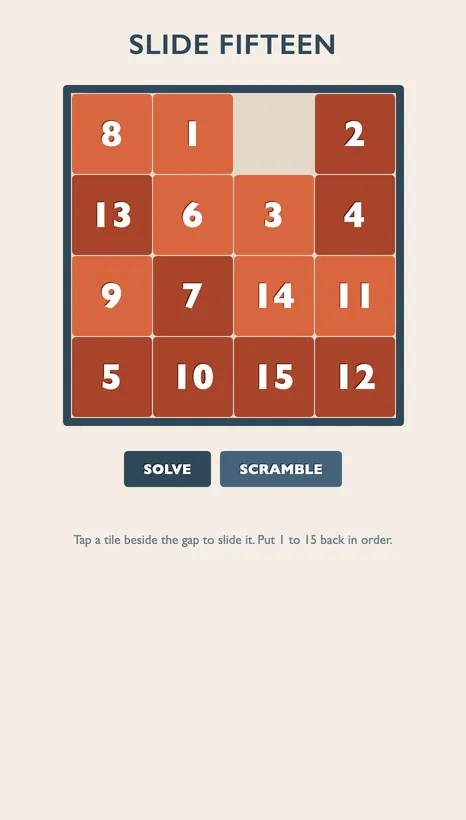
Captured from this build on 2026-09-14.
Tips from playing it
- Finish the top row first, then the second, and never disturb a row you have already placed.
- Solve the last two tiles of a row as a pair. Placing them one at a time is what forces you to break the row open again.
- Leave the bottom two rows until the end and treat them as one puzzle rather than two separate rows.
- When you are stuck, walk the gap in a small circle around the tile you want. The tile follows the gap, not your finger.
Why this game is here, and what we changed
Our version of the sliding tray started life in dark teal with a developer credit and a code link sitting under the buttons. We took both off the page, gave it a title of its own, and rebuilt the palette in terracotta on warm sand so it belongs beside our other puzzles instead of looking like a leftover. The slide logic and the solver are as they were. We played it at phone width, scrambled and solved it twice, and checked that a tap two tiles away from the gap really does shift the whole line.
More on how we pick and fix these: how we make our own editions of classic games and how we test a game.
We wrote about this one
- How we make our own editions of classic games. A tableau of cards, a sliding tile square, four discs in a row. Nobody owns those rules. Here is what goes into turning one of them into a game that holds up on a phone.
- Category
- Puzzle
- Plays in
- Your browser, no download
- Orientation
- Landscape
- Players
- One player.
- Difficulty
- Easy to fiddle with, fiddly to actually finish.
- Typical session
- Four to ten minutes from a scramble.
- Last tested by us
- 2026-09-14