Link Loop
About Link Loop
Link Loop is our own connect-the-dots puzzle. Join every matching pair of coloured dots with a path, filling the whole grid without crossing any line. Level one is a five by five grid holding four pairs, in green, blue, red and yellow, and the grids work up to nine by nine from there. There is also a fresh daily board that is the same for everybody.
How to play
Drag from one coloured dot to the dot of the same colour. Paths turn in right angles, cannot cross each other, and cannot run through a dot they do not belong to. Every pair has to be joined before the level clears. You have a limited number of strokes, so a sloppy route can cost you the level.
Rules of Link Loop
- The line under the level number names the grid size and how many pairs are sitting on it, so you know the shape of the job before you start.
- A path follows the grid. It turns in right angles and never cuts across a diagonal.
- A path cannot run through another dot and cannot cross a line you have already drawn.
- A counter under the title reads how many pairs are joined, so the board tells you what is still outstanding.
- The move number at the top left counts down from your budget rather than up from zero.
- Finishing a level pays coins into the counter at the top right, and the next level opens straight away.
- Hint and Restart sit under the board. Restart wipes every line without taking you out of the level.
Controls
- Drag from a dot to its matching pair to draw a path
- Drag over an existing path to redraw it from that point
- Tap a dot to clear its path
What makes it worth playing
- Grids grow from five by five up to nine by nine as you progress
- Colour count rises with the grid, from four upward
- Clearing a level pays coins into the counter at the top and opens the next board immediately
- A stroke budget, so tidy routes matter and a messy solve can fail
- A daily board generated from the date, identical for every player
- Hint and restart without leaving the board
Screenshots
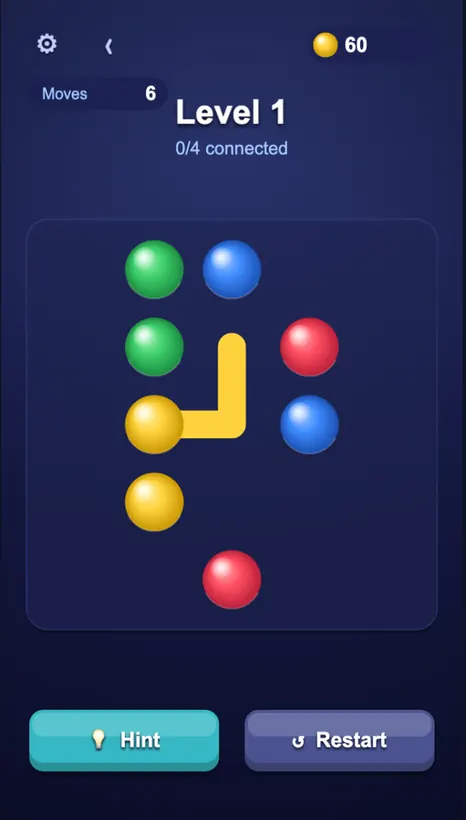
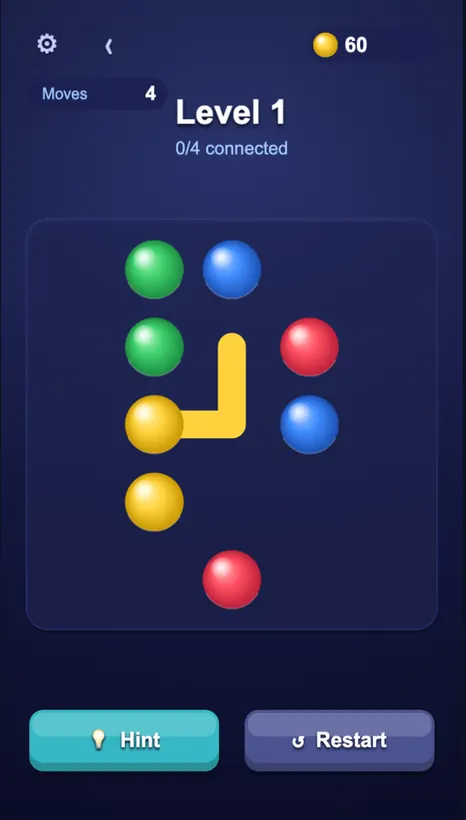
Captured from this build on 2026-08-26.
Tips from playing it
- Start in the corners. A dot in a corner has only two directions it can leave from, so its first move is usually forced.
- Follow the edges next. Edge cells have fewer neighbours, which means fewer possible paths through them.
- Trust the connected counter under the level number over your own eye. Two of four joined means two pairs are still sitting there, however finished the board looks.
- Watch the stroke count. A perfect solve needs one stroke per colour, and the budget gives you roughly half that again in slack.
Notes from building it
The interesting design problem in this game was the stroke budget. A perfect solve needs exactly one stroke per colour, so the temptation is to set the budget there and call it elegant. In practice that punishes the wrong thing: on a touchscreen a stroke gets broken by a slightly lifted finger, not by bad reasoning, and losing a level to your own thumb is infuriating. So the budget is one stroke per colour plus about half again, plus one. That is loose enough that ordinary mistakes and redraws are survivable, and tight enough that a genuinely sloppy run, where you are drawing paths to see what happens rather than working it out, runs out. The other decision worth naming is that the budget is on screen the whole time, counting down beside the level number rather than sitting in a menu. A player who can see what a redraw costs makes a different and better decision from one who cannot, and the pair counter next to it does the same job for progress: it tells you plainly how many pairs are still outstanding, so nobody has to squint at a board trying to work out whether they are nearly done.
More from the studio: why difficulty needs a rhythm and how we test a game.
Link Loop is also on Android. Get it on Google Play. That is the only place we link installs from.
- Category
- Puzzle
- Plays in
- Your browser, no download
- Orientation
- Portrait
- Players
- One player.
- Difficulty
- Easy to pick up, tricky once the grid reaches seven by seven
- Typical session
- 1 to 5 minutes a level
- Last tested by us
- 2026-08-26
- Studio
- Our own game