Copper Table
About Copper Table
Copper Table is a single pinball table built on a real physics engine, so the ball has weight and keeps whatever momentum you give it. Three bumpers sit in the upper triangle, two slings guard the flippers, and a plunger lane runs up the right hand side. You get three balls. Everything between the launch and the drain is down to how well you read the ball. There is no ramp, no multiball and no mode stack to learn, which makes it a table you can pick up in ten seconds and still be bad at twenty minutes later.
How to play
The ball starts low in the lane on the right. Hold a flipper button to wind the plunger up, then let go to fire it round the top rail. From then on the two buttons are your left and right flippers.
Rules of Copper Table
- Three balls a game. When the third one goes past the flippers the run is over and your score is banked.
- While the ball is sitting in the lane, any press charges the plunger. The flippers stay still until it leaves.
- A tap launches at minimum power, a full hold at maximum, and anything between lands somewhere in the middle.
- Bumpers score a hundred and shove the ball away hard. Slings score twenty five.
- Nothing else on the table scores, so a ball that quietly rolls down the middle is worth nothing at all.
- Your highest total is kept on the device and shown next to the live score.
Controls
- Hold either flipper button while the ball sits in the lane to charge the plunger
- Let go to launch, and the longer the hold the further round the rail it travels
- Left button works the left flipper, right button the right
- On a keyboard, Z and the forward slash key, or the arrow keys
What makes it worth playing
- A real physics body on the ball rather than a scripted path, so no two drains look the same
- Three bumpers worth a hundred each, packed close enough that a trapped ball keeps scoring on its own
- Slings above each flipper worth twenty five, which fling the ball back up instead of letting it dribble down
- Angled deflectors at mid height that turn a ball hugging the side wall back toward the middle
- A charge gauge that fills in the lane so you can see exactly how hard the next launch will be
Screenshots
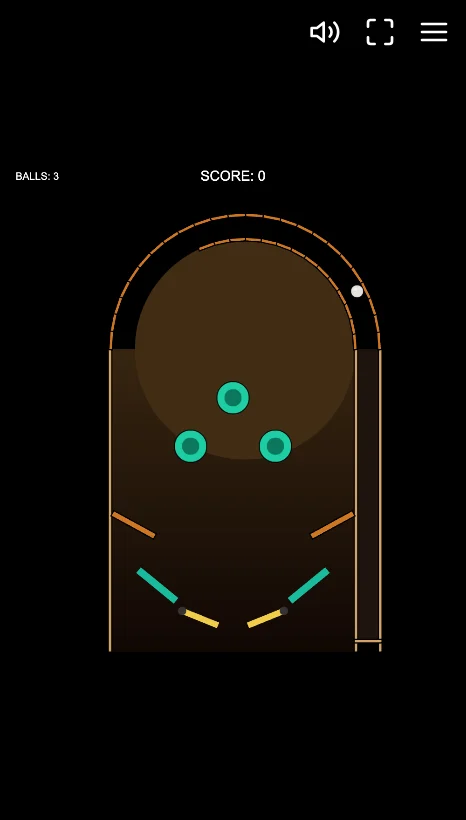
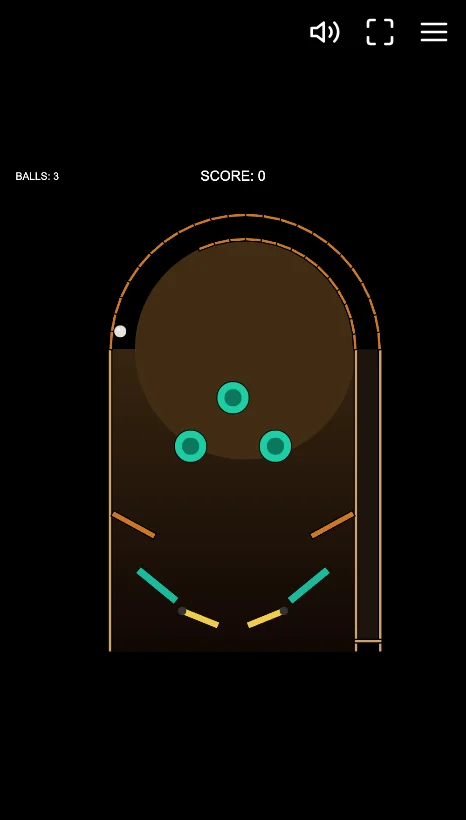
Captured from this build on 2026-09-14.
Tips from playing it
- Let the ball settle onto a flipper before you swing. Flapping at everything sends it straight down the middle.
- A weak launch drops the ball in from the right, a full one carries it round to the left. Pick the side you want to defend.
- The three bumpers are the whole scoring engine, and each one kicks the ball straight back out from its own centre. A ball wedged between two of them will bank points without your help, so leave it alone.
- When the ball is heading for the gap between the flippers, a late flick from the far side is better odds than a panic from the near one.
Why this game is here, and what we changed
Tracking a pale ball across a blue playfield on a phone is harder than it should be, so the table went warm and the ball stayed cool. Brass walls, copper rails, gold flippers, teal bumpers that flash white on contact, and a pewter ball that now separates from everything under it. The lane tint is doing a job as well as a look: it turns green the moment the plunger is armed, which is the only cue that a press will charge rather than flip. The physics constants were left where they were found.
More on how we pick and fix these: how we make our own editions of classic games and how we test a game.
We wrote about this one
- How we make our own editions of classic games. A tableau of cards, a sliding tile square, four discs in a row. Nobody owns those rules. Here is what goes into turning one of them into a game that holds up on a phone.
- Category
- Arcade
- Plays in
- Your browser, no download
- Orientation
- Portrait
- Players
- One at the cabinet, with the highest total sitting beside the live score.
- Difficulty
- Only the bumpers and the slings pay anything, so a ball that never reaches the upper triangle can survive for a minute and score nothing at all.
- Typical session
- Three to eight minutes a game.
- Last tested by us
- 2026-09-14