Ricochet Grid
About Ricochet Grid
Ricochet Grid is a drop and bounce game about long odds. A cannon at the top of a teal board fires a single ball into a field of pegs, and gravity does the rest. Round pegs are filler. The rose squares are what you came for, and there are around fourteen of them hiding in the crowd. One ball can clip two of them and die, or it can work its way across the whole field and take eight. You cannot steer it once it leaves the barrel, so a good shot is one you set up rather than one you pilot.
How to play
Move the pointer or touch the board to swing the cannon, then tap to drop a ball. Clear every rose square before the ten balls run out.
Rules of Ricochet Grid
- You get ten balls a round, and the round ends the moment the last rose square falls.
- Round pegs pay 100, rose squares pay 1000, and the single cyan square pays 5000.
- Hitting the cyan square also slows the board to a third speed for three seconds, which is long enough to watch a chain happen.
- Every four pegs struck on one ball lifts the multiplier by one, and it drops back to one when you fire again.
- A ball keeps 78 per cent of its speed off each peg, and anything slower than 3.5 units is pushed back up to it, so a busy shot stays alive for a long time.
- A violet tray slides along the floor. Catch a ball in it for 2500 points and the ball comes back to you.
- The field is rebuilt every round as ten columns by eleven rows, offset row by row, with the rose squares held at least 2.6 units apart.
- Aim is held inside a wide cone around straight down, so no shot can be fired sideways into a wall.
Controls
- Move the pointer or touch the board to aim, then tap to drop
- Space drops a ball along the current aim
- Arrow keys or a gamepad stick sweep the cannon
What makes it worth playing
- A chevron trail out of the barrel that thins as it goes, so the drop angle is clear before you commit.
- The score sits big in the centre, with squares left on one side and balls left on the other.
- Slow motion on the cyan square, which stretches the best shot of a round out into something you can follow.
- A sliding tray that hands a ball back, so a careless round can still be recovered.
Screenshots
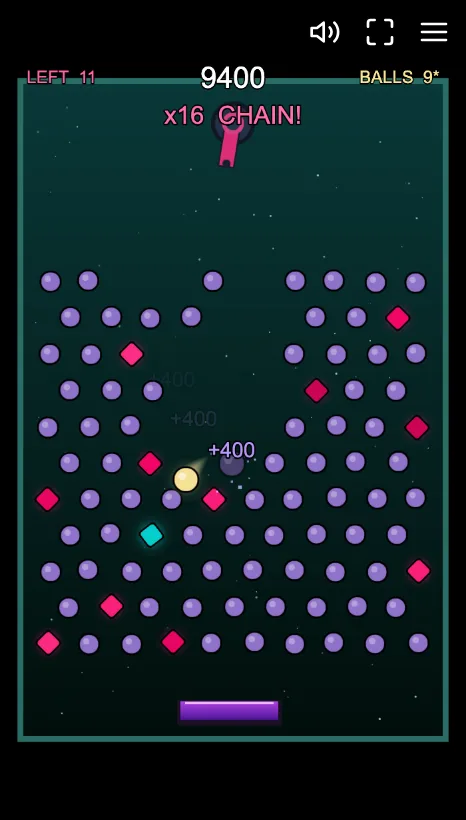
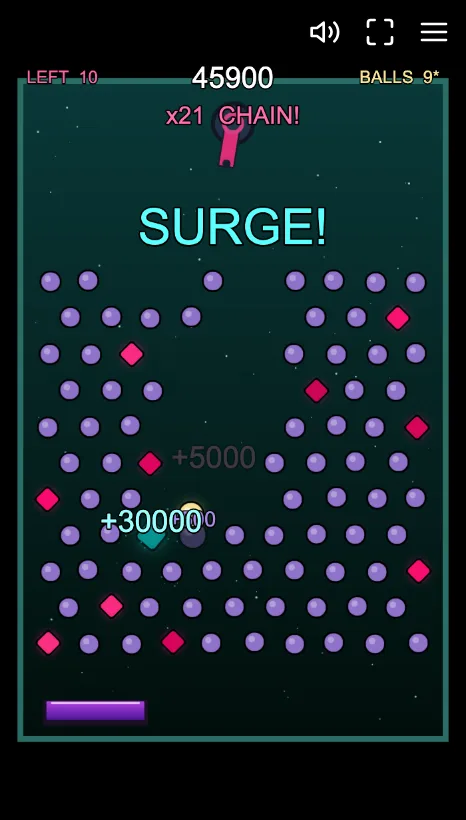
Captured from this build on 2026-09-14.
Tips from playing it
- Pick the rose square with the most round pegs under it. The ball carries on working after the first hit.
- Chase length over accuracy. The multiplier only moves every fourth peg on a single ball, so eight pegs on one shot is worth double four pegs on two.
- Time the tray. It sweeps on a fixed sine, so aim at where it will be rather than where it is, and a catch is worth a free ball and 2500 points.
- Leave the cyan square for a shot that already has somewhere to go, because three slow seconds are wasted on an empty corner.
Why this game is here, and what we changed
Shape carries the scoring here, not just colour. Anything that pays is a rounded square and everything that is filler stays a circle, so a target reads at a glance on a phone. Rose squares for the thousand, one cyan square for the five thousand, lilac circles for the hundred, all on a teal board with eighty twinkling stars behind it. The score sits in the middle of the top bar with the two counts either side of it, and the aim guide is a run of seven chevrons that shrink and fade along the line rather than a single arrow. The bounce numbers stayed put. That part was already right.
More on how we pick and fix these: how we make our own editions of classic games and how we test a game.
We wrote about this one
- How a game gets tested before it goes on this site. Every game here is played through on a real phone-sized screen before it is published. Here is the checklist, and the bugs it has actually caught.
- Category
- Arcade
- Plays in
- Your browser, no download
- Orientation
- Portrait
- Players
- A single cannon operator per round, with the best score held on your device.
- Difficulty
- Ten balls against a field that is rebuilt every round, and the last rose square is always the one sitting where no bounce wants to take you.
- Typical session
- Three to seven minutes a round.
- Last tested by us
- 2026-09-14