Domino Chain
About Domino Chain
Domino Chain is the blocking version of dominoes, one hand against the computer, no drawing from a pile. Both sides take seven tiles from the double six set, the highest double on the table opens, and from then on you are matching a number on one of your tiles to whichever number is showing at either end of the line. Run out of tiles and you win. Get stuck with the board locked and the lower pip total wins instead, so the endgame is less about playing tiles and more about which ones you are prepared to be caught holding.
How to play
Tap a playable tile in your hand, then tap the L or R panel to add it to that end of the line. Tiles with no legal placement are dimmed and cannot be picked up at all.
Rules of Domino Chain
- The full double six set is used, twenty eight tiles in all.
- Each side draws seven tiles and the rest of the set is left out of the round entirely.
- Whoever holds the highest double opens with it. If neither side has a double, the heaviest tile opens.
- A tile can be added to either end of the line if one of its numbers matches the number showing at that end.
- Doubles are laid crossways, and they still only offer their single number to the line.
- With no pile to draw from, a side that cannot go passes automatically and play comes back round.
- Empty your hand and you take the round outright.
- If both sides pass in a row the board is locked, and the side holding fewer pips wins. Equal pips is a draw.
Controls
- Tap a tile in your hand to pick it up
- Tap L or R to place it at that end of the line
- Tapping a different tile switches your pick, and a dimmed tile never takes it
- ESC pauses, and the pause panel can quit to the front screen
What makes it worth playing
- Playable tiles stay bright while dead ones dim, so your options read at a glance.
- When a tile fits both ends you get two panels to choose from, and a crossed out panel when only one end works.
- Doubles lie across the line the way they should, so the chain looks like a real table.
- The computer's hand stays face down at the top and thins out as it plays, so you can count what is left.
- The whole round runs on one screen with no scrolling, on a phone as well as a laptop.
Screenshots
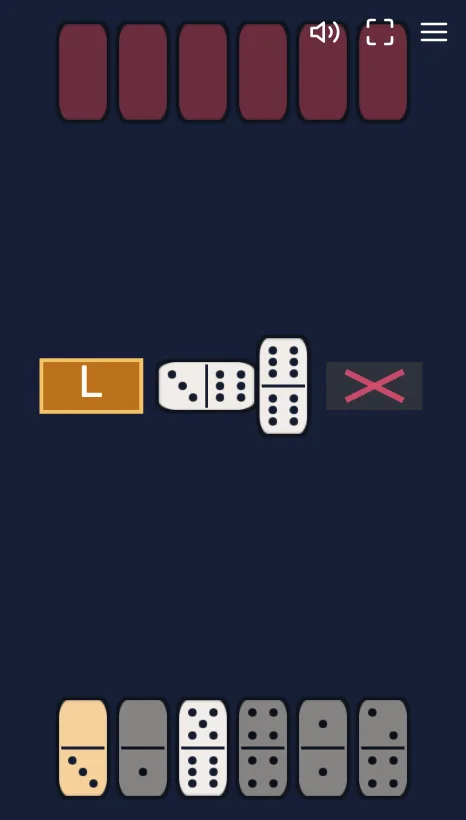
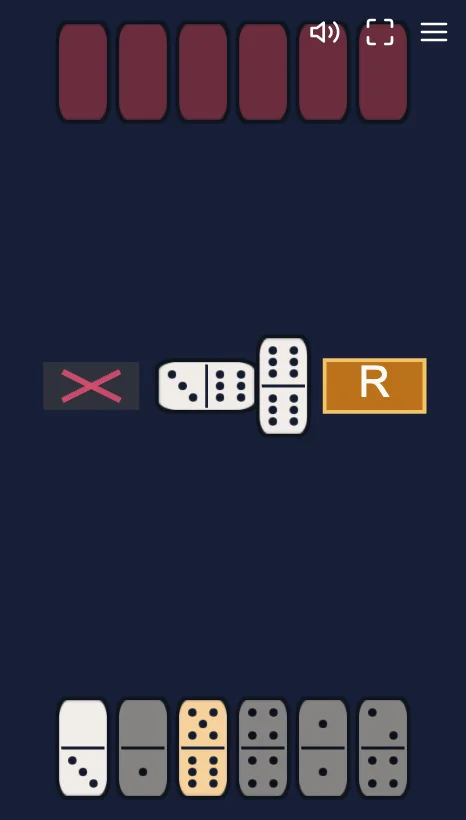
Captured from this build on 2026-09-14.
Tips from playing it
- The computer never sees your hand. It samples thirty possible versions of it each turn, searches six plies into each, and plays whichever tile wins the vote, so it is guessing well rather than cheating.
- Play your doubles early. A double only ever matches one number, so it is the hardest tile to get rid of late on.
- Watch what the computer declines to play. A number it keeps skipping is a number it does not hold, and its sampling will keep skipping it.
- If you can make both ends show the same number, do it. That halves what your opponent can answer with.
- When the board is clearly heading for a lock, dump your heaviest tiles even on a poor placement. Pip total is what gets counted.
Why this game is here, and what we changed
A deep indigo table, ivory tile faces, ink blue pips, and dark wine backs so the computer's hand reads as a hand rather than as scenery. The placement panels are amber with a bright border, which holds up far better against the new felt than green would, and the panel you cannot use is crossed out instead of simply missing, so a bad pick tells you why. One thing we did not add: an auto placement when a tile only fits one end. It is a single extra tap and it keeps the choice yours.
More on how we pick and fix these: how we make our own editions of classic games and how we test a game.
We wrote about this one
- An opponent that cannot see your hand. Everyone assumes the computer cheats at dominoes. The one here guesses your hand thirty times a turn instead, and the way it guesses is exactly the gap you can play into.
- Category
- Board
- Plays in
- Your browser, no download
- Orientation
- Portrait
- Players
- You hold seven tiles, the computer holds the other seven, and fourteen never enter the round.
- Difficulty
- The computer samples thirty possible versions of your hand every turn and searches six plies into each, so it plays the odds well even though it cannot see a single one of your tiles.
- Typical session
- Three to six minutes a round.
- Last tested by us
- 2026-09-14