Lattice Go
About Lattice Go
Lattice Go is the full territory game on a nine by nine grid, which is the size most people finish. You and the computer take turns dropping stones on the intersections, and the point is not to cover the board but to fence off more of it than the other side. Surround an enemy group completely and it comes off. Wall in an area and the empty points inside it count for you at the end. Nine lines across keeps a game to about a quarter of an hour while leaving every idea in the big version intact, including the awkward ones about when to stop taking and start defending.
How to play
Tap an intersection to set a stone down. A faint stone in your own colour previews the placement, and illegal points refuse it. Use the Pass button when no move helps you, and two passes in a row finish the game.
Rules of Lattice Go
- Black sets the first stone, then the two sides alternate.
- Stones go on the intersections of the grid, not inside the squares, and they never move once placed.
- A group of touching same colour stones shares its breathing spaces, the empty points directly next to it.
- Fill the last breathing space of an enemy group and every stone in it is lifted off the board.
- You may not place a stone that would leave its own group with no breathing space, unless the placement captures something first.
- A move that would rebuild the position as it stood one turn earlier is refused, which stops an endless recapture.
- Pass when nothing helps. Two passes in a row end the game at once.
- Your score is your stones on the board plus the empty points you have enclosed, with seven added for white, and the larger total wins.
Controls
- Tap any empty intersection to place a stone
- Pass in the top bar gives the turn away
- P is the keyboard shortcut for passing, R restarts
- ESC brings up the pause panel
What makes it worth playing
- A nine by nine grid with the usual star points marked, so it reads like a real board.
- Illegal placements are simply refused, including filling your own last liberty.
- The capture count for both colours sits at the top and ticks over as groups come off.
- Scoring at the end is by area, with a seven point allowance for white, and a hundred quick playouts decide which stones were dead before the count.
- Three opponent budgets: three hundred playouts, one second, or three and a half seconds of search a move.
Screenshots
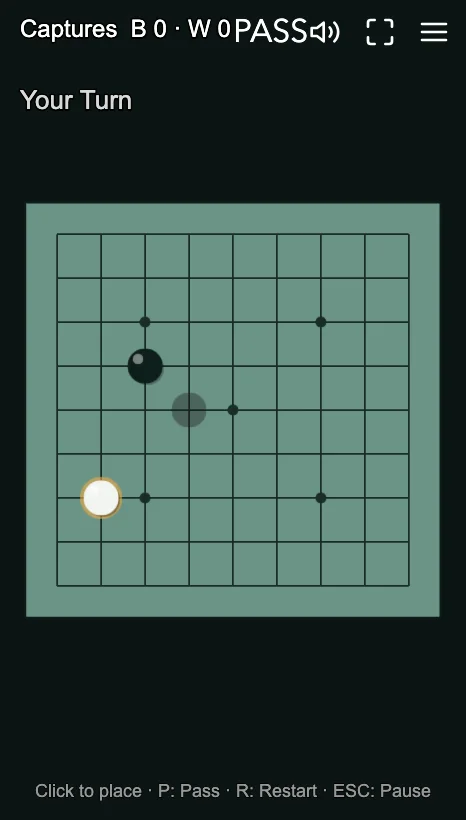
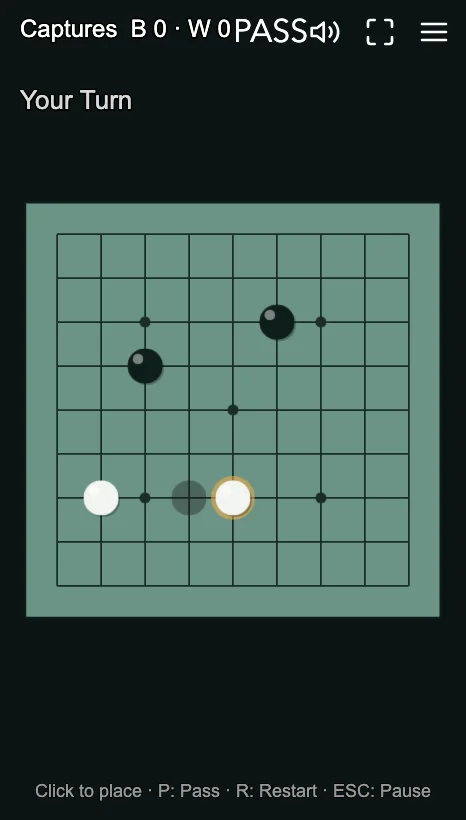
Captured from this build on 2026-09-14.
Tips from playing it
- The seven point komi decides most close games here. On a board this small you are usually playing for a five point margin, so a single careless exchange is the whole match.
- Easy gets three hundred playouts and will answer a contact fight without reading past it. Push straight into its groups and it will fill its own liberties.
- The hard budget of three and a half seconds is a fixed spend per move, so it plays the crowded middle game far better than it plays the quiet opening. Take your big points early.
- Two separate eyes make a group permanently safe, and the scoring pass will mark anything without them as dead, so shapeless stones cost you twice.
- Pass rather than fill your own territory at the end. Under area scoring each stone inside your own wall is a point you handed back.
Why this game is here, and what we changed
Sage green field, ink green lattice, stones in near black and bone rather than gloss. The cooler half of the palette went here so the two board games on the site never get mistaken for each other. Two smaller fixes matter more in play: the toolbar carries the word PASS next to the speaker, and at around five hundred pixels wide it overran its button and touched the icon, so this board widens the text frame and drops the label a size. The difficulty descriptions in Options were wrong about the search and now name the real budgets. The rules and the seven point komi are untouched.
More on how we pick and fix these: how we make our own editions of classic games and how we test a game.
- Category
- Board
- Plays in
- Your browser, no download
- Orientation
- Portrait
- Players
- Black against the computer at three search budgets, two humans on one device, or the machine running both colours.
- Difficulty
- Nine lines keep the board small, but the hard opponent spends three and a half seconds of Monte Carlo search on every move and it does not blunder a capture.
- Typical session
- Twelve to twenty minutes a game.
- Last tested by us
- 2026-09-14