Marble Chess
About Marble Chess
Marble Chess is a full game of chess with nothing trimmed out of it. Castling both sides, en passant, underpromotion, the fifty move rule, threefold repetition and insufficient material all resolve properly, so a drawn ending is drawn for the right reason. Pick up a piece and every square it can legally reach lights up, which takes the fiddliness out of playing on a small screen without taking the thinking out of the game. The board carries file letters and rank numbers along the edges, so you can follow a line the way you would read it in a book.
How to play
Tap a piece and the squares it can legally reach are ringed. Tap one of those squares to play the move.
Rules of Marble Chess
- White opens, and the two sides alternate for the rest of the game.
- Pawns step forward one square, or two from their starting rank, and they only take on the diagonal.
- Knights jump in an L and are the only piece allowed to pass over anything in the way.
- Bishops run on the diagonals, rooks run along ranks and files, and the queen does both.
- The king moves one square in any direction and can never step into an attacked square.
- Castling is legal only when neither the king nor that rook has moved, the squares between them are clear, and the king is not in check nor passing through one.
- A pawn that has just gone two squares can be taken in passing by an enemy pawn beside it, and only on the very next move.
- A pawn on the last rank must promote, and the panel lets you take a rook, bishop or knight instead of a queen.
- Checkmate ends it. Stalemate, threefold repetition, fifty moves without a capture or pawn push, and insufficient material are all drawn.
Controls
- Tap a piece, then tap a ringed square
- The arrow in the top bar takes back your last move
- U also undoes, R starts a new game, ESC pauses
- When a pawn reaches the end, a panel asks what it should become
What makes it worth playing
- Three strengths of opponent: easy picks at random from the legal moves, medium searches three plies, and hard deepens to six inside a one and a half second budget.
- Legal destinations are ringed the instant you lift a piece, and an illegal one simply is not offered.
- A king sitting in check is washed rose, so you cannot miss it.
- The last move played stays lit in gold, which makes it easy to pick up a paused game.
- Promotion asks you to choose. A knight is on the menu when a knight is the move.
- Two people can share the screen, and there is a machine against machine mode if you just want to watch.
Screenshots
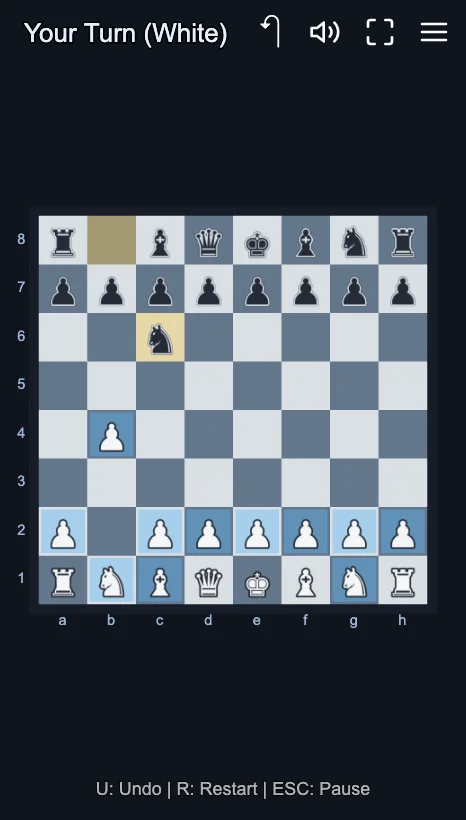
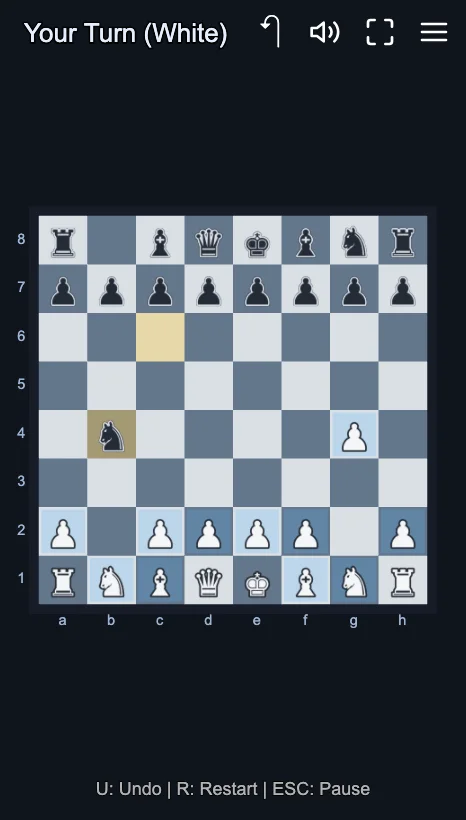
Captured from this build on 2026-09-14.
Tips from playing it
- Bring both knights and both bishops out before you move anything twice. The engine's own scoring pays a bonus for every piece off its back rank.
- Get the king tucked away early. Pawns standing in the three squares in front of the king are worth about ten centipawns each to the machine, and it drops that bonus entirely once the queens come off.
- On medium the search is three plies deep, so it will take a piece it can see and walk into a recapture on the fourth move. Bait it.
- Rooks want open files. When a pawn trade opens one, put a rook there before your opponent does.
- In a king and pawn ending the engine switches to its endgame table and starts marching its own king forward. Do the same or you will be outflanked.
Why this game is here, and what we changed
The turn banner used to sit centred across the top, which put it directly under the toolbar icons on a narrow screen. It now hangs on the left and stays clear of everything. The look changed with it: pale marble squares over slate blue, pieces cut in near white against graphite with the outline reversed on the dark set, and the file and rank labels in a soft steel that reads without shouting. The search itself we did not touch, tables and all. Beating it is supposed to be work.
More on how we pick and fix these: how we make our own editions of classic games and how we test a game.
We wrote about this one
- How we make our own editions of classic games. A tableau of cards, a sliding tile square, four discs in a row. Nobody owns those rules. Here is what goes into turning one of them into a game that holds up on a phone.
- Category
- Board
- Plays in
- Your browser, no download
- Orientation
- Portrait
- Players
- White is yours against three grades of engine, a second person can take black, or both colours can be handed to the machine.
- Difficulty
- The hard opponent deepens to six plies inside a one and a half second budget, and it scores doubled, isolated and passed pawns, so a structural mistake is remembered for the rest of the game.
- Typical session
- Ten to twenty five minutes a game.
- Last tested by us
- 2026-09-14