Felt Break
About Felt Break
Felt Break is a solo pool table with the physics turned all the way up. Cushions, cut angles and combination shots all behave the way they do on a real cloth, which means a rebound off two rails is a legitimate route to a ball you cannot see a line to. There is nobody on the other side of the table. Fifteen balls, one cue ball, and a counter that goes up every time you strike. The whole game is trying to beat the number you finished on last time.
How to play
With a mouse, point where you want the cue ball to go and click. On a touchscreen, drag out behind the cue ball like drawing a real cue and lift your finger to strike. Either way the distance from the ball sets the power. Wait for the table to settle before the next one.
Rules of Felt Break
- The table is cleared when all fifteen numbered balls are down, and that is the end of the round.
- You are scored on strokes, not points. Every strike of the cue ball adds one.
- Solids and stripes are decoration. There are no groups and no opponent, so you can take any ball in any order.
- Potting the cue ball is a scratch. Nothing is deducted, but the stroke still counts and you place the cue ball by hand before shooting again.
- A cue ball in hand cannot be dropped against a rail, touching another ball, or close enough to a pocket to fall straight in. The preview turns red where the spot is refused.
- Cushions, spin and combinations behave properly, so banking off two rails to reach a blocked ball is a real option.
- The lowest stroke count you have ever finished a table in is saved and shown on the title screen.
Controls
- Mouse: point at the target, and the distance from the cue ball sets the power
- Touch: drag out behind the cue ball and release to fire the other way
- The wheel nudges the power up or down before you commit
- Hold the right mouse button to fast forward a slow table, and R racks a fresh set
What makes it worth playing
- Full cushion and contact physics, so the cue ball keeps travelling after impact and you can play position
- A stroke counter with your lowest ever finish kept beside it
- Fifteen numbered balls on a proper rack, and no groups to claim, so every ball is always on
- Ball in hand after a scratch, with the ghost ball tinted red wherever the spot is not legal
- An overhead view that rotates the whole table upright in portrait rather than shrinking it into a letterbox
Screenshots
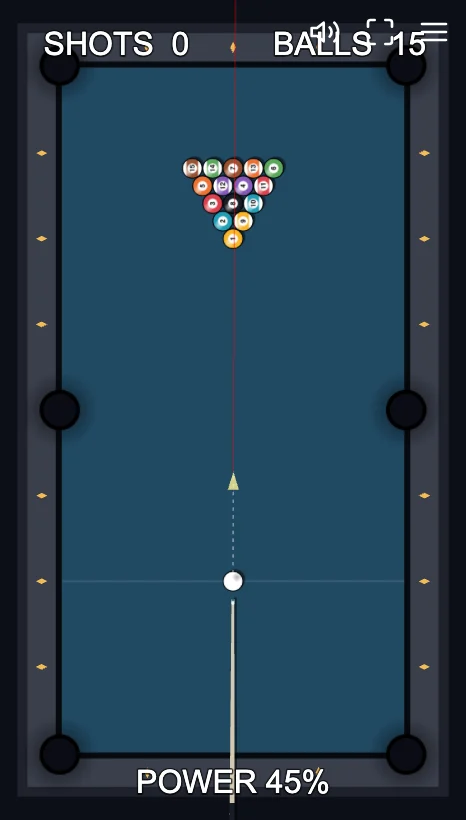
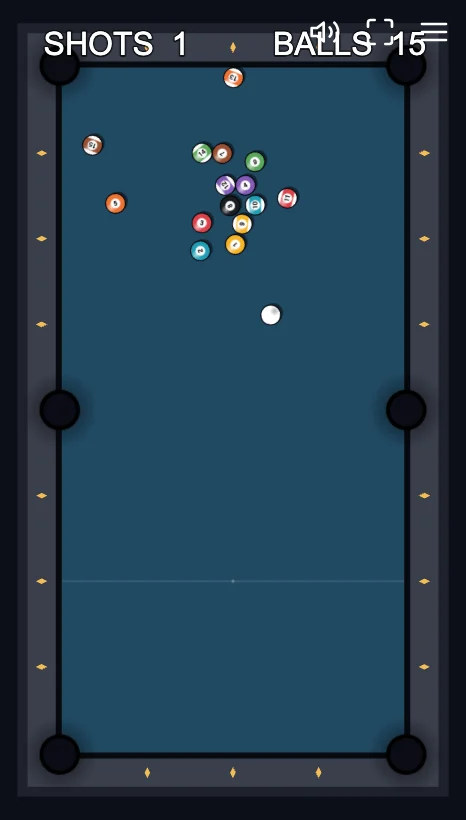
Captured from this build on 2026-09-14.
Tips from playing it
- Aim at the point on the object ball furthest from the pocket, not at the middle of it. That contact point is what sends it in.
- Think about where the cue ball ends up, not just whether the current shot drops. A pot that leaves you snookered has cost you two strokes.
- Even a click at zero power fires a soft tap rather than nothing, so a delicate nudge is a real shot here. Use it to break up a pair on the rail.
- Break the cluster early while you still have easy balls elsewhere. Leaving it until the end is how a twenty stroke table becomes a forty stroke one.
Why this game is here, and what we changed
Slate blue cloth in place of green, charcoal rails in place of orange timber, and brass sight diamonds inlaid along both sides. The ball set was recut and renamed to a warmer range, bone, amber, lagoon, coral, iris, ember, moss, clay and ink, all of which survive being scaled down to a phone. Two working changes came with it: the help screen now says that a scratch still costs the stroke, and the ball in hand preview goes red on an illegal spot rather than quietly refusing. The rack order is untouched, apex ball through to the back row.
More on how we pick and fix these: how we make our own editions of classic games and how we test a game.
- Category
- Sports
- Plays in
- Your browser, no download
- Orientation
- Portrait
- Players
- Nobody racks up against you. The rival is your own lowest finish.
- Difficulty
- Nothing stops you taking any ball in any order, so the only opponent is the stroke count on the title screen and the cue ball position you leave yourself.
- Typical session
- Six to twelve minutes a table.
- Last tested by us
- 2026-09-14